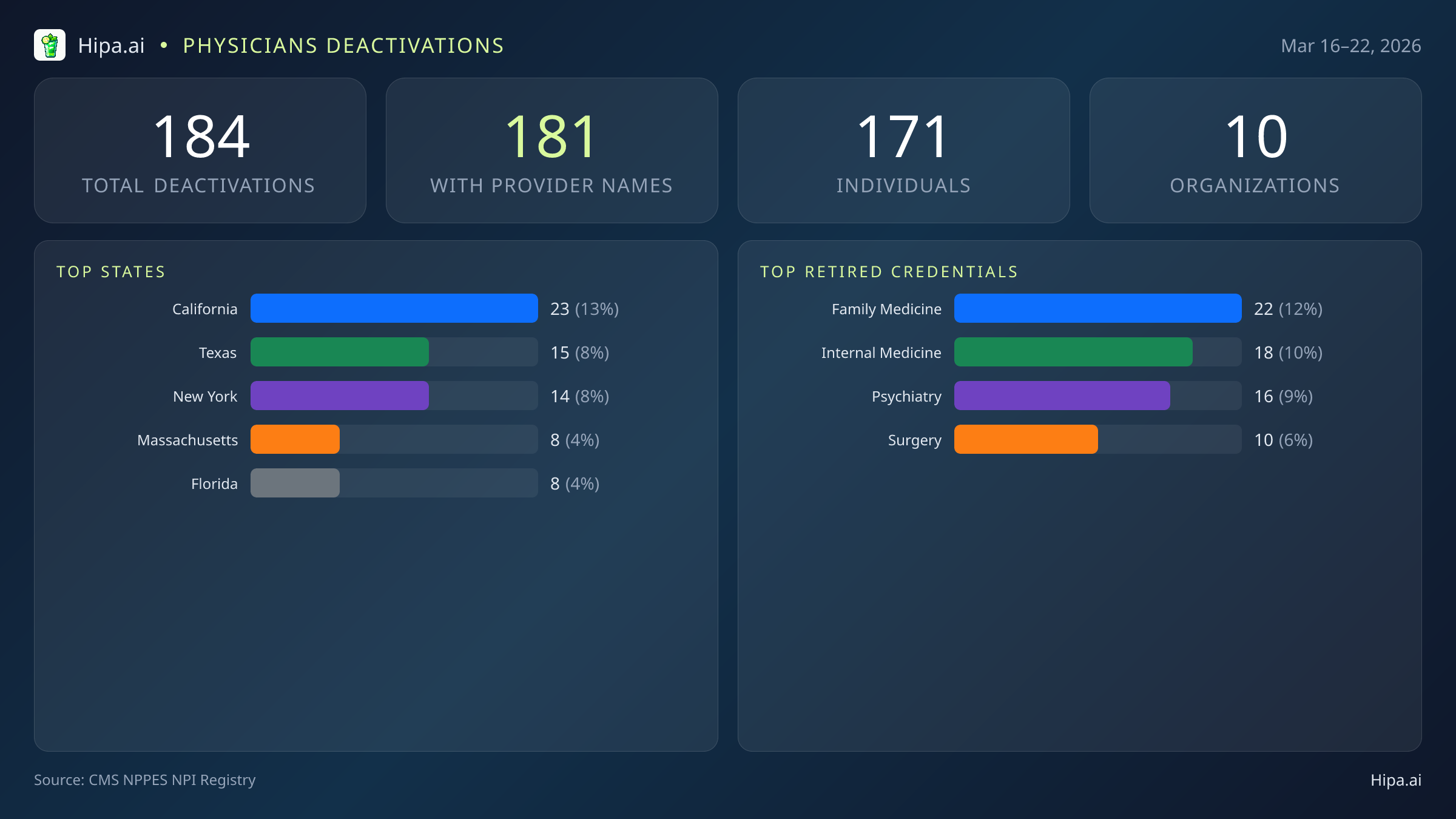
This week, the CMS National Provider Identifier (NPI) registry recorded 184 deactivations within the Physicians category. Of these, 181 records, representing 98%, had retrievable names through Hipa.ai's cache. The remaining 3 records had their identifying information removed by CMS due to privacy policies. California led all states with 23 deactivations. The majority of deactivations, 171, were for individual physicians, with 10 deactivations for organizations.
Geographic Concentration of Deactivations
Geographically, California registered the highest number of physician NPI deactivations this week, with 23 records, accounting for 13% of the national total. Texas and New York followed, each with 15 and 14 deactivations respectively, both representing 8% of the total. Other states with notable deactivation counts included Massachusetts, Florida, and Pennsylvania, each recording 8 deactivations, or 4%. Georgia, Puerto Rico, New Jersey, and Missouri each saw 6 deactivations, representing 3%. At the city level, Houston, TX, recorded the most deactivations with 5, followed by New York, NY, with 4. This distribution often reflects states and metropolitan areas with larger physician populations and higher rates of professional mobility or retirement.
Diverse Physician Specialties Affected
Among the 181 named deactivated records, the most frequently observed primary taxonomy was 207Q00000X, representing Family Medicine, with 22 deactivations, or 12%. Internal Medicine (207R00000X) accounted for 18 deactivations, or 10%. Psychiatry (2084P0800X) saw 16 deactivations, representing 9%, while Surgery (208600000X) had 10 deactivations, or 6%. Other significant taxonomies included 207L00000X (Anesthesiology) and 207P00000X (Ophthalmology), each with 8 deactivations, or 4%. This mix of general practice and specialized fields indicates a broad range of physician types undergoing NPI status changes, reflecting the diverse nature of the medical workforce.
Deactivations Reflect Registry Maintenance
NPI deactivations are administrative updates within the federal registry and do not inherently signify license actions, malpractice, or that a provider has stopped practicing. Providers may deactivate an NPI for various reasons, including retirement, changing practice locations, consolidating multiple NPIs, or transitioning between entity types. The year-over-year increase in deactivations is a natural consequence of the registry's aging and the ongoing churn within the U.S. healthcare workforce, encompassing both individual practitioners and organizational entities.