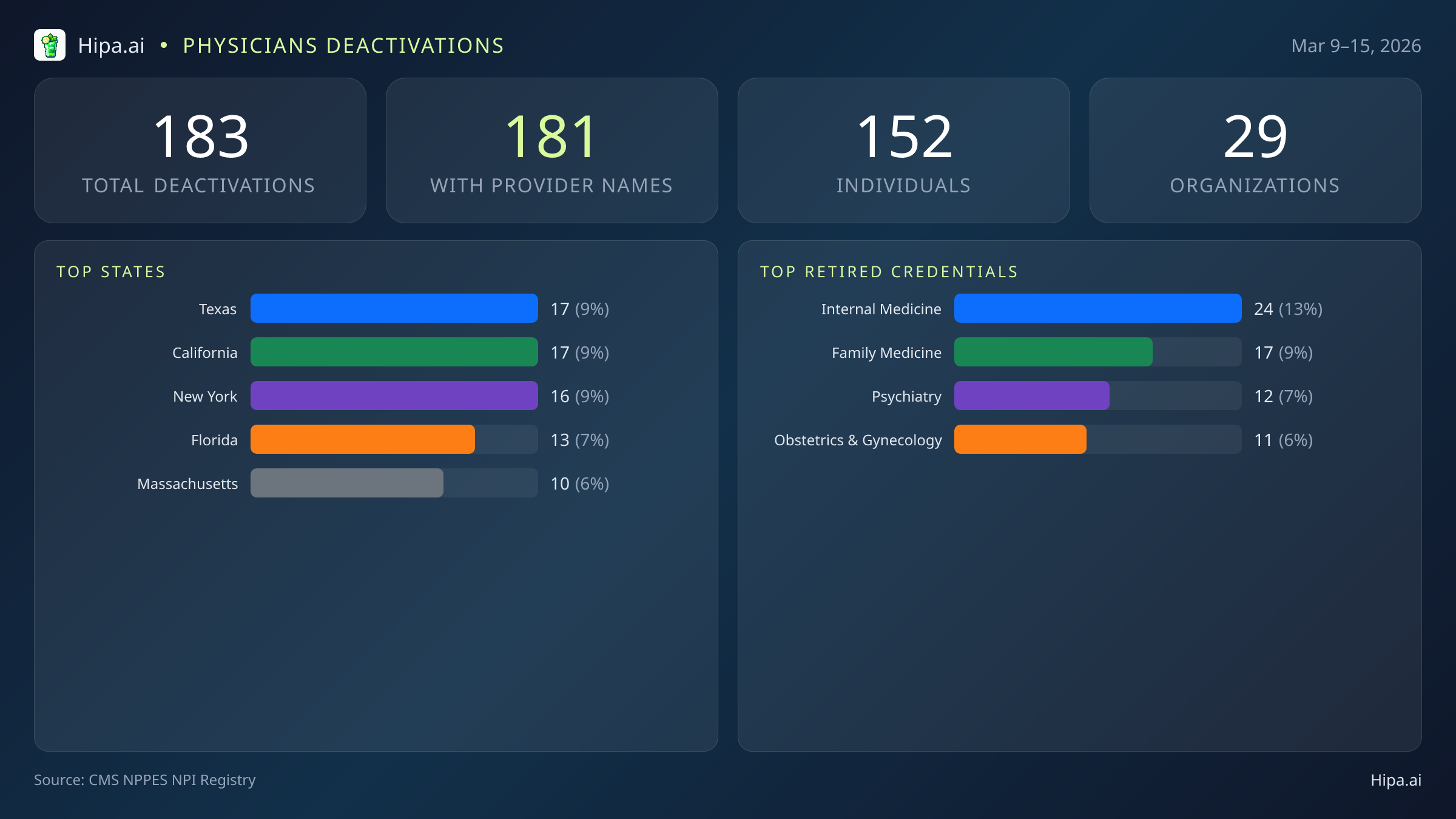
The CMS National Provider Identifier (NPI) registry recorded 183 deactivations within the Physicians segment for the week of March 9-15, 2026. Of these, 181 records included retrievable names, while 2 records were scrubbed by CMS in accordance with its privacy policy for deactivated entries. Texas and California registered the highest number of deactivations, each with 17 entries.
Geographic Distribution of Deactivations
Geographically, Texas and California each accounted for 9% of the total deactivations for the week, with 17 entries in each state. New York followed closely with 16 deactivations, also making up 9% of the total. Florida reported 13 deactivations, or 7%, while Massachusetts and Nevada each saw 10 deactivations, contributing 6% apiece. Illinois recorded 8 deactivations (4%), and Washington, Michigan, and Ohio each had 7 deactivations (4%). This distribution highlights administrative activity across states with significant healthcare workforces. The majority of these deactivations, 152, were for individual physicians, with 29 deactivations pertaining to organizations.
Specialty Mix Among Deactivated NPIs
Analysis of the primary taxonomies among the named deactivated records reveals a diverse mix of medical specialties. Internal Medicine (207R00000X) was the most frequent, with 24 deactivations, accounting for 13% of the named subset. Family Medicine (207Q00000X) followed with 17 deactivations (9%). Psychiatry (2084P0800X) saw 12 deactivations (7%), while Obstetrics & Gynecology (207V00000X) recorded 11 deactivations (6%). Pediatrics (208000000X) also contributed significantly with 10 deactivations (6%). Other notable specialties included Surgery (2085R0202X) and Cardiovascular Disease (207RC0000X), each with 7 deactivations (4%). This broad representation across specialties indicates that NPI deactivations are a routine administrative process affecting various areas of medical practice, reflecting changes across the healthcare landscape.
Understanding NPI Deactivations
An NPI deactivation is an administrative status change within the federal NPPES registry and does not, by itself, indicate a license action, malpractice, or that a provider has ceased practicing. Providers may obtain a new NPI, retire, change their entity type, or have their record retired for clerical reasons. Deactivations tend to rise year over year as the registry ages and as providers naturally transition roles or consolidate their NPI records. This week's data reflects the ongoing administrative maintenance of the U.S. healthcare workforce registry, capturing routine changes in provider and organizational NPI statuses as part of the dynamic nature of the healthcare sector.