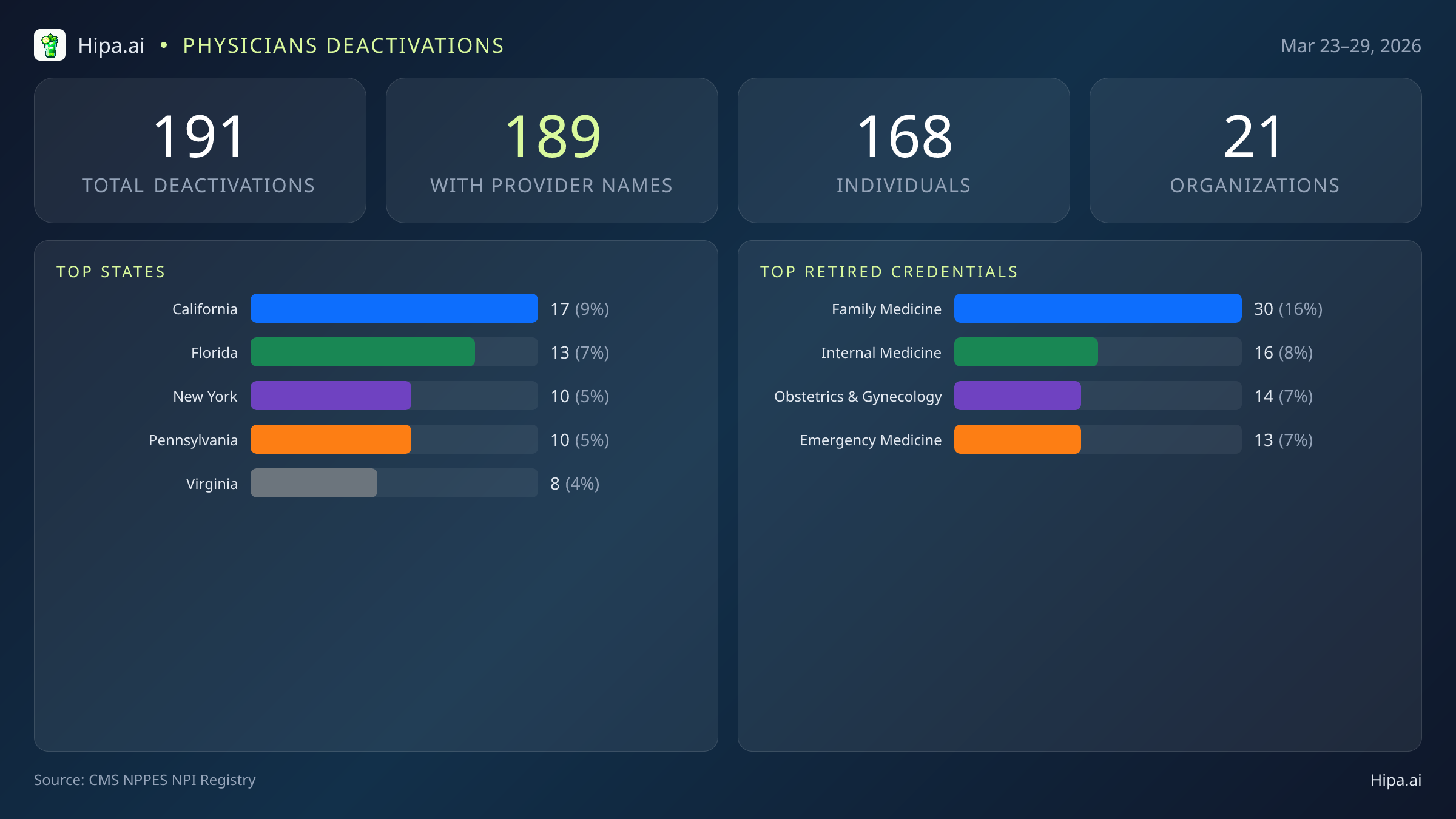
The CMS National Provider Identifier (NPI) registry recorded a total of 191 deactivations within the Physicians segment during the week of March 23-29, 2026. Of these, Hipa.ai's name cache successfully retrieved identifying information for 189 records, representing approximately 99% of the total. The remaining 2 records had their name and address information removed by CMS, a standard practice for deactivated NPIs in accordance with federal privacy policies. California led all states with 17 physician deactivations during this period, marking it as the state with the highest volume of administrative NPI changes for physicians this week.
Geographic Distribution of Deactivations
Geographically, deactivations were most concentrated in states with large healthcare workforces and high population densities. California registered the highest number of physician deactivations with 17 records, accounting for 9% of the national total. Florida followed with 13 deactivations, representing 7% of the week's activity. New York and Pennsylvania each recorded 10 deactivations, both contributing 5% to the total. Other states with notable deactivation counts included Virginia, Maryland, and Texas, each reporting 8 deactivations. This distribution often reflects the overall size and administrative churn within state-level provider populations, rather than specific workforce reductions.
Physician Taxonomy Trends
Among the named deactivated physicians, several broad medical specialties were prominent, indicating a diverse range of practitioners undergoing administrative status changes. The taxonomy code 207Q00000X, which represents Family Medicine, was the most frequent, appearing in 30 records or 16% of the named deactivations. Internal Medicine (207R00000X) followed with 16 records, making up 8% of the subset. Obstetrics/Gynecology (207V00000X) accounted for 14 deactivations, while Pediatrics (207P00000X) saw 13 deactivations, each representing 7% of the named total. Diagnostic Radiology (2084P0800X) also registered 10 deactivations, or 5%. This mix of primary care and specialty fields suggests that NPI deactivations are a widespread administrative process across the physician landscape.
Understanding NPI Deactivations
It is important to note that NPI deactivations are administrative updates within the federal registry and do not inherently indicate licensure actions, malpractice, or a permanent cessation of practice. Providers may deactivate an NPI for various reasons, including retirement, changing practice locations, consolidating multiple NPIs under a new organizational structure, or transitioning to a different entity type. The consistent volume of deactivations observed year over year reflects the dynamic nature of the U.S. healthcare workforce and the continuous maintenance required for the NPPES database to ensure accurate and up-to-date provider information.