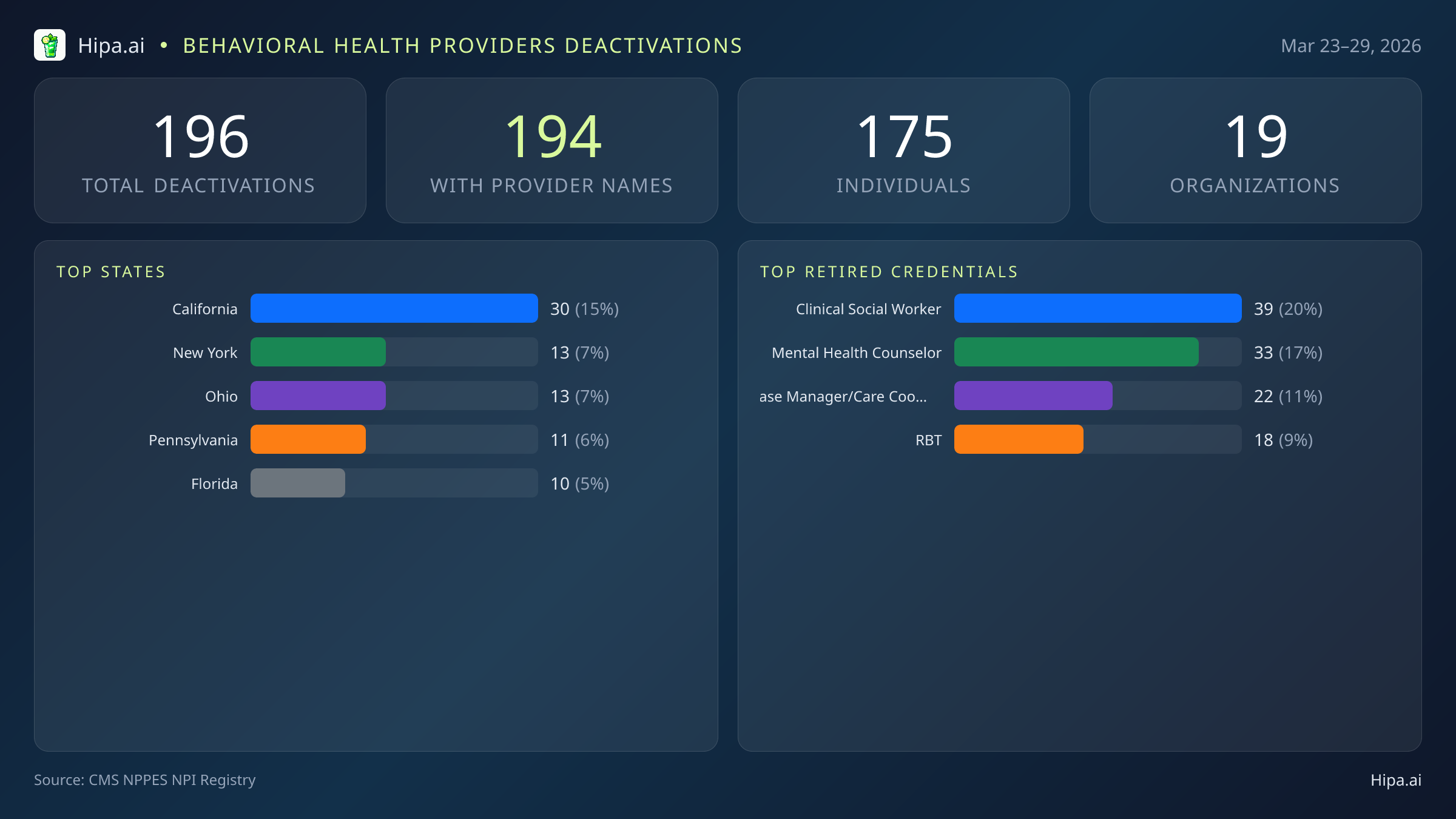
The CMS National Provider Identifier (NPI) registry recorded 196 deactivations within the Behavioral Health Providers segment during the week of 2026-W13, spanning March 23-29, 2026. Of these, Hipa.ai's public-source name cache captured names for 194 records before CMS removed identifying information, while 2 records were scrubbed. California led the nation in deactivations for this category, accounting for 30 providers.
Geographic Trends in Deactivations
A review of the deactivated NPIs shows a concentration in states with large healthcare markets. California registered the highest number of deactivations, with 30 records, representing 15% of the total. New York and Ohio each saw 13 deactivations, making up 7% respectively. Pennsylvania followed with 11 deactivations, or 6%, and Florida reported 10 deactivations, or 5%. This distribution often reflects the overall size and dynamism of the healthcare workforce in these populous states.
Credential Mix Among Deactivated Providers
Among the named deactivated records, individual providers comprised the vast majority, with 175 individuals compared to 19 organizations. The leading taxonomy for deactivations was Clinical Social Worker, with 39 records, accounting for 20% of the named providers. Mental Health Counselors followed closely with 33 deactivations, or 17%. Acupuncturists represented 22 deactivations (11%), while Registered Behavior Technicians (RBTs) and Specialist/Technologists each accounted for 18 and 17 deactivations, or 9% respectively. Addiction Counselors also saw 14 deactivations, making up 7% of the named records.
Understanding NPI Deactivations
NPI deactivations are administrative updates within the federal NPPES registry. This status change does not inherently indicate a license action, malpractice, or that a provider has ceased practicing entirely. Providers may obtain a new NPI, retire, change their entity type, or have their record retired for various clerical reasons. Deactivations are a regular occurrence in the registry, and their numbers tend to increase year over year as the registry ages and as providers naturally transition roles or retire from practice.