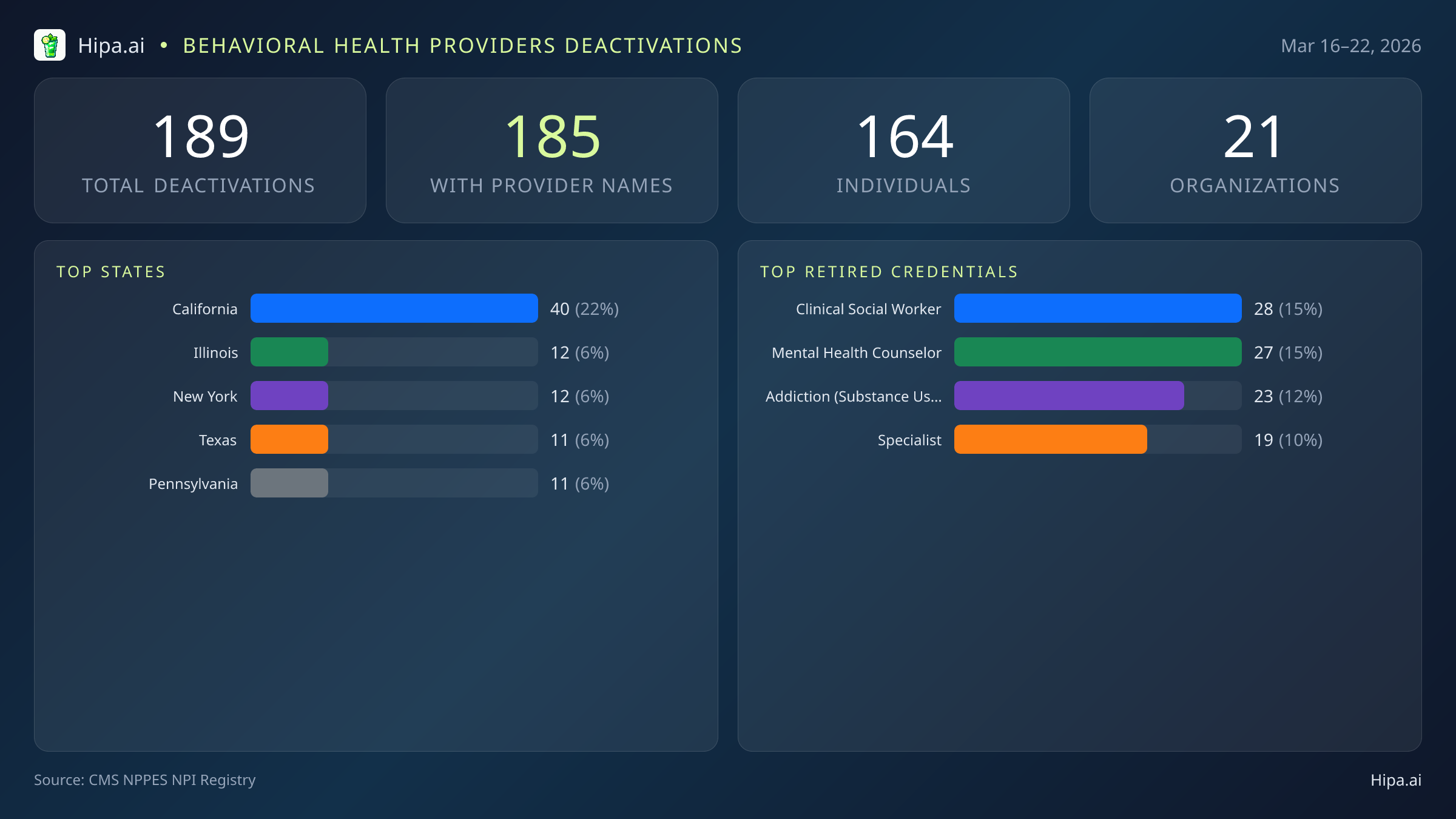
The CMS National Provider Identifier (NPI) registry recorded 189 deactivations in the Behavioral Health Providers segment this week, spanning March 16-22, 2026. Of these, Hipa.ai's name cache captured 185 provider names before CMS's privacy policy removed identifying information from 4 scrubbed records. Individuals accounted for 164 deactivations, while 21 were organizations. California led all states, with 40 deactivations during this period.
Geographic Patterns in Deactivations
Geographically, NPI deactivations for behavioral health providers were most concentrated in California, which represented 22% of the total with 40 records. Illinois and New York each saw 12 deactivations, accounting for 6% respectively. Texas and Pennsylvania followed closely, each with 11 deactivations, also representing 6% of the week's total. This concentration in populous states often reflects larger provider bases and higher rates of administrative changes within the NPI registry.
Credential Mix Among Deactivated Records
An analysis of the named deactivated records reveals a diverse mix of behavioral health professionals. Clinical Social Workers represented the largest group, with 28 deactivations, or 15%. Mental Health Counselors followed with 27 deactivations, also 15%. Addiction Counselors accounted for 23 deactivations, or 12%. Other notable categories included Specialist/Technologist with 19 deactivations (10%), Registered Behavior Technicians (RBTs) with 18 deactivations (10%), and Psychologists with 12 deactivations (6%). This distribution highlights the broad range of specialties within the behavioral health sector undergoing NPI status changes.
Contextualizing NPI Deactivations
NPI deactivations are a routine part of maintaining the federal registry and do not inherently indicate a cessation of practice or disciplinary action. Providers may have their NPI deactivated for various administrative reasons, such as retirement, changing their entity type, obtaining a new NPI, or consolidating multiple NPIs. The observed deactivations reflect ongoing administrative adjustments within the U.S. healthcare workforce, contributing to the dynamic nature of the NPPES registry.