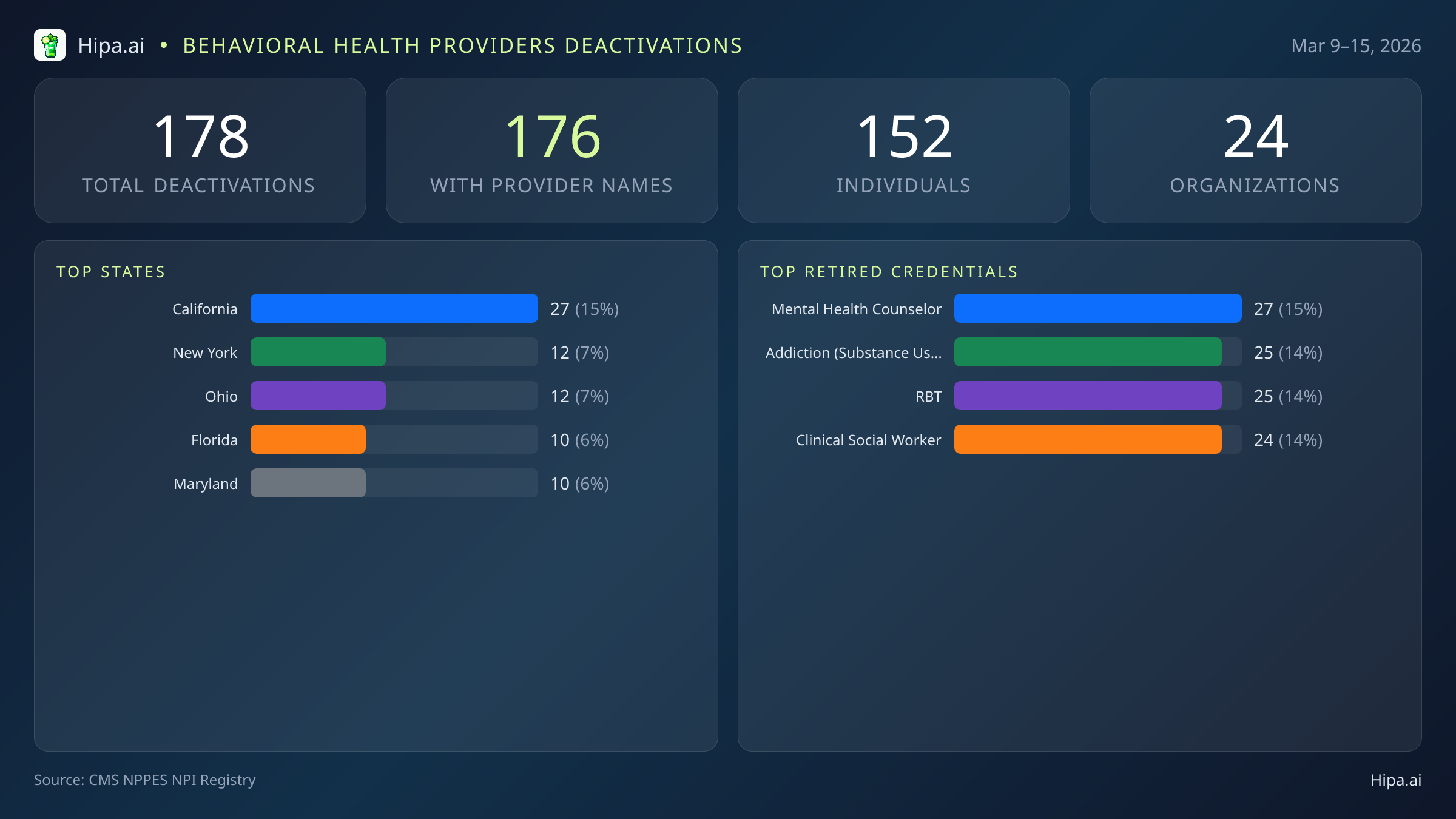
The CMS National Provider Identifier (NPI) registry recorded 178 deactivations in the Behavioral Health Providers segment this week, from March 9 to March 15, 2026. Of these, Hipa.ai's name cache captured 176 named records before CMS privacy policies removed identifying information, leaving 2 scrubbed records. California recorded the highest number of deactivations, with 27 entries.
Geographic Distribution of Deactivations
Geographically, California led the nation in behavioral health provider deactivations, accounting for 27 records, or 15% of the week's total. New York and Ohio followed, each reporting 12 deactivations, indicating a notable volume of administrative changes in these populous eastern and midwestern states. Florida, Maryland, and Michigan each saw 10 deactivations, further illustrating a pattern of activity across diverse regions. This concentration in states with large healthcare markets often reflects a higher overall number of providers and, consequently, more frequent administrative updates related to workforce mobility or evolving practice structures.
Key Behavioral Health Taxonomies
Analysis of the named deactivated records reveals that individual providers constituted the vast majority, with 152 entries, while 24 organizations also saw their NPIs deactivated. The most frequently deactivated taxonomy was Mental Health Counselor, with 27 records, representing 15% of the named total. Addiction Counselor and Registered Behavior Technician (RBT) categories each recorded 25 deactivations, highlighting significant administrative activity among these critical support and direct care roles. Clinical Social Workers accounted for 24 deactivations, underscoring their substantial presence in the behavioral health landscape. This diversity in deactivated taxonomies points to the broad spectrum of professionals within the behavioral health sector undergoing routine administrative NPI status changes.
Understanding NPI Deactivations
NPI deactivations are standard administrative status changes within the federal NPPES registry. They do not, by themselves, indicate a license action, malpractice, or that a provider has ceased practicing. Providers may obtain a new NPI, retire, change their entity type, or have their record retired for clerical reasons. Deactivations tend to rise year over year as the registry ages and as providers retire or consolidate organizations. The observed deactivations reflect routine maintenance of the federal registry and the continuous evolution and administrative churn within the U.S. healthcare workforce, rather than necessarily a reduction in active practitioners.