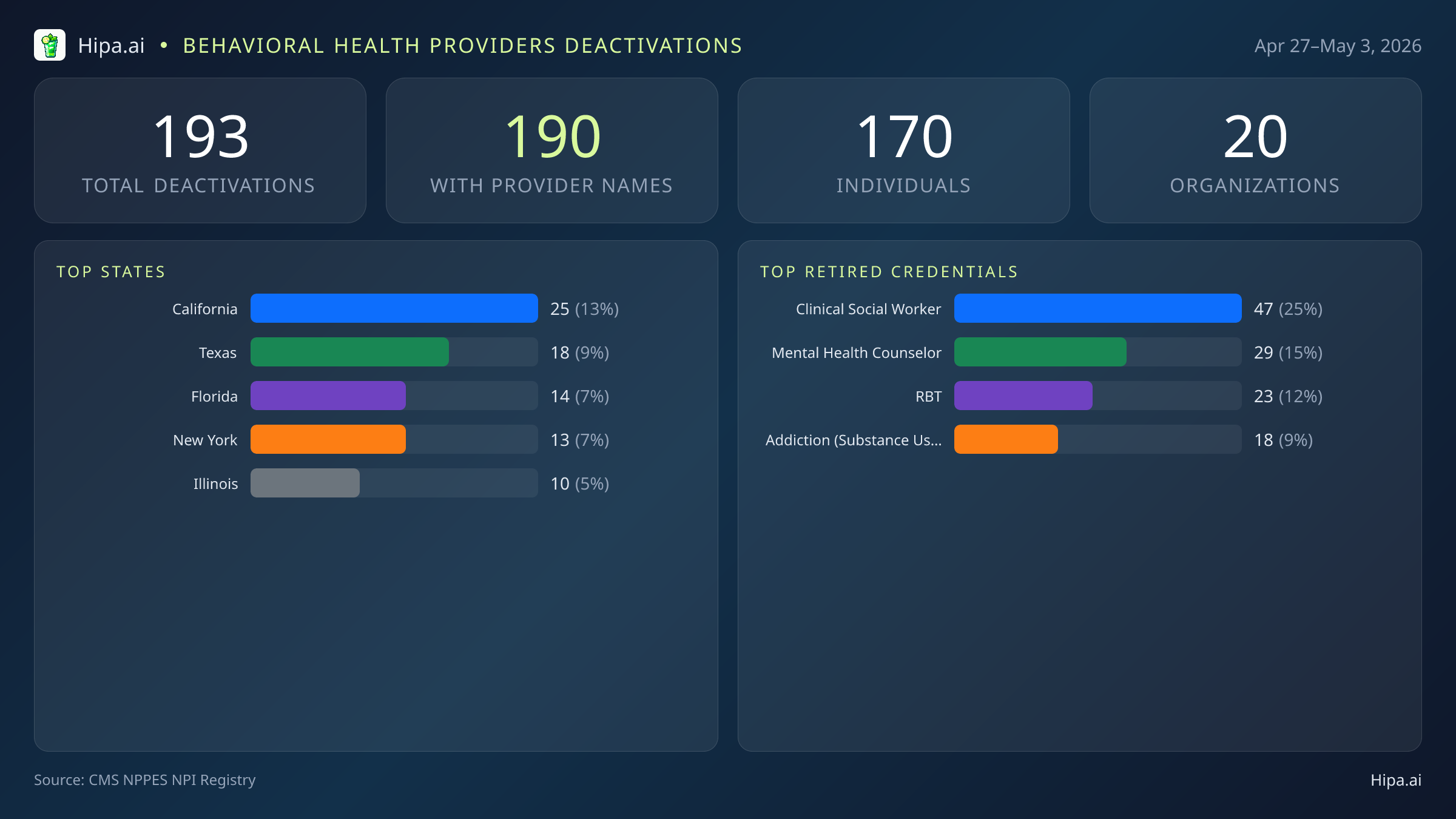
The CMS National Provider Identifier (NPI) registry recorded 193 deactivations within the Behavioral Health Providers segment for the week of April 27 to May 3, 2026. Of these, Hipa.ai's name cache captured 190 records with retrievable names, while 3 records had their identifying information removed by CMS due to privacy policies. California led the states with the highest number of deactivations, accounting for 25 records, or 13% of the national total.
Geographic Deactivation Trends
Following California's 25 deactivations, other states also showed notable activity. Texas registered 18 deactivations, representing 9% of the total, while Florida and New York each had 14 and 13 deactivations, respectively, each accounting for 7%. Illinois reported 10 deactivations, or 5%. This concentration in highly populated states is consistent with broader patterns in healthcare workforce changes, where larger provider bases naturally experience more administrative updates to their NPI records.
Credential and Taxonomy Mix
An analysis of the named deactivations reveals the primary taxonomies affected. Clinical Social Workers constituted the largest group, with 47 deactivations, or 25% of the named providers. Mental Health Counselors followed with 29 deactivations, representing 15%, and Registered Behavior Technicians (RBTs) accounted for 23 deactivations, or 12%. Addiction (Substance Use Disorder) Counselors saw 18 deactivations, making up 9%. The data indicates that 170 deactivations were for individual providers, while 20 deactivations were for organizations, reflecting administrative changes across both individual practitioners and larger entities in the behavioral health sector.
Context of NPI Deactivations
NPI deactivations are administrative actions within the federal NPPES registry and do not inherently indicate disciplinary action, malpractice, or a cessation of practice. Providers may have their NPI deactivated for various reasons, including retirement, changing practice locations, consolidating multiple NPIs, or obtaining a new NPI under a different entity type. As the NPI registry continues to age, an annual increase in deactivations is expected as part of routine database maintenance and ongoing workforce churn within the U.S. healthcare system.