Rilvegostomig is a PD-1/TIGIT bispecific antibody, representing an innovative approach in cancer immunotherapy. This page provides a comparison of Rilvegostomig with established PD-1/PD-L1 inhibitors such as Pembrolizumab (Keytruda), Nivolumab (Opdivo), Atezolizumab (Tecentriq), and Durvalizumab (Imfinzi). Its dual mechanism targeting both PD-1 and TIGIT pathways offers a distinct therapeutic strategy.
Rilvegostomig Alternatives: How It Compares to Other PD-1 & TIGIT Inhibitors
Hipa.ai Research · Source: ClinicalTrials.gov / AACT · Last updated: AI-augmented data · 0/7 curated
Source: ClinicalTrials.gov via AACT · Hipa.ai, 2026-05-07Download chart as PNG
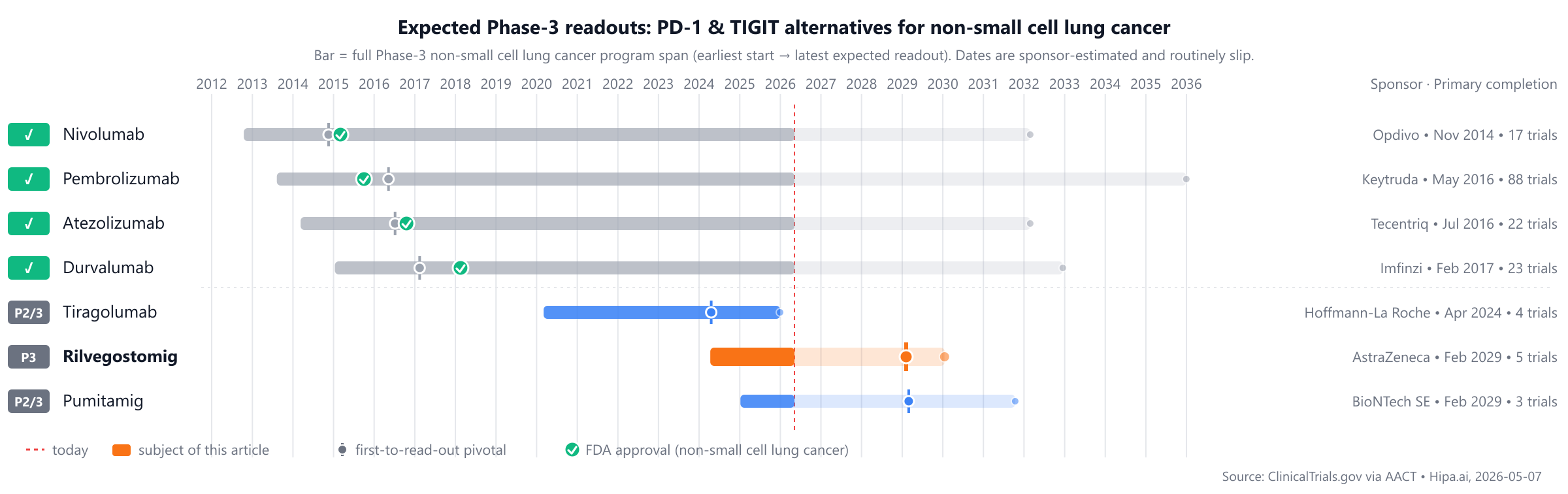
The competitive landscape includes established therapies like Pembrolizumab (Keytruda) and Nivolumab (Opdivo), both approved in 2014. Rilvegostomig is not yet approved, while pipeline candidates Tiragolumab and Pumitamig are still in Phase 3 development, approximately 1-2 years behind the latest approved drugs.
Quick comparison table
| Drug | Class | Approved indications | Dosing | Year approved | Lead pivotal endpoint | Annual cost (rough) |
|---|---|---|---|---|---|---|
| Rilvegostomig | PD-1/TIGIT bispecific antibody | — | — | Pipeline | — | — |
| Nivolumab (Opdivo) | PD-1 inhibitor | Melanoma, Non-small cell lung cancer, Malignant pleural mesothelioma, +8 more | 240 mg every 2 weeks or 480 mg every 4 weeks intravenously | 2015 | 9.2months @ median | $168k |
| Pembrolizumab (Keytruda) | PD-1 inhibitor | melanoma, non-small cell lung cancer, head and neck squamous cell carcinoma, +3 more | 200 mg every 3 weeks or 400 mg every 6 weeks intravenously | 2015 | 0.6Hazard Ratio @ 5 years | $191k |
| Atezolizumab (Tecentriq) | PD-L1 inhibitor | Non-small cell lung cancer, Small cell lung cancer, Hepatocellular carcinoma, +2 more | 1200 mg intravenously every 3 weeks | 2016 | 13.8months @ median | $191k |
| Durvalumab (Imfinzi) | PD-L1 inhibitor | bladder cancer, non-small cell lung cancer, small cell lung cancer, +4 more | 1500 mg intravenously every 3 to 4 weeks | 2018 | Progression-Free Survival: 16.8months @ median | — |
| Tiragolumab | TIGIT inhibitor | — | — | Pipeline | — | — |
| Pumitamig | PD-L1/VEGF bispecific antibody | — | — | Pipeline | — | — |
Cost estimates are list-price approximations and do not reflect rebates, formulary tier, or out-of-pocket costs after benefits. The class-typical lead-pivotal endpoint here is Overall Survival; cells render each drug's actual pivotal endpoint, which may differ. The "Year approved" column shows the FDA approval year for non-small cell lung cancer specifically — drugs approved for other indications first appear with their this-indication date, or as Pipeline if not yet approved for this indication. Cross-trial comparisons can mislead — head-to-head Phase-3 data (when present) is below.
Rilvegostomig vs Pembrolizumab (Keytruda)
The pivotal head-to-head evidence comes from a head-to-head Phase-3 trial (NCT06692738) enrolling 880 participants, primary completion 2029-02.
Primary-endpoint values for NCT06692738 are not yet posted in the AACT results database.
Source: ClinicalTrials.gov via AACT — pulled directly from the trial's posted results. View the full trial record.
Rilvegostomig vs Nivolumab (Opdivo)
The pivotal head-to-head evidence comes from a head-to-head Phase-3 trial (NCT07431281) enrolling 2,130 participants, primary completion 2029-08.
Primary-endpoint values for NCT07431281 are not yet posted in the AACT results database.
Source: ClinicalTrials.gov via AACT — pulled directly from the trial's posted results. View the full trial record.
Rilvegostomig vs Atezolizumab (Tecentriq)
The pivotal head-to-head evidence comes from a head-to-head Phase-3 trial (NCT06921785) enrolling 1,220 participants, primary completion 2029-03.
Primary-endpoint values for NCT06921785 are not yet posted in the AACT results database.
Source: ClinicalTrials.gov via AACT — pulled directly from the trial's posted results. View the full trial record.
Rilvegostomig vs Durvalumab (Imfinzi)
The pivotal head-to-head evidence comes from a head-to-head Phase-3 trial (NCT07221253) enrolling 1,100 participants, primary completion 2029-07.
Primary-endpoint values for NCT07221253 are not yet posted in the AACT results database.
Source: ClinicalTrials.gov via AACT — pulled directly from the trial's posted results. View the full trial record.
Pipeline alternatives
Beyond currently available options, several investigational drugs are advancing through Phase 3 development. Among these is Tiragolumab from Hoffmann-La Roche, an investigational agent with its lead Phase 3 trial identified as NCT04619797. This compound is approximately 1-2 years behind other advanced investigational alternatives. Also in Phase 3 is Pumitamig, developed by BioNTech SE, with its lead study listed under NCT06712316. Pumitamig represents a different mechanism of action, functioning as an IL-17A nanobody.
Choosing between Rilvegostomig and its alternatives
Choosing between Rilvegostomig and established PD-1 or PD-L1 inhibitors involves considering their distinct mechanisms of action. Rilvegostomig, as a PD-1/TIGIT bispecific antibody, targets two immune checkpoints simultaneously, which may offer a broader or enhanced immunomodulatory effect compared to agents that target only PD-1 or PD-L1. This dual mechanism could be a differentiating factor for clinicians seeking to engage multiple pathways in the tumor microenvironment. While specific efficacy data for Rilvegostomig is still emerging, its bispecific nature represents a novel approach in checkpoint inhibition.
Conversely, clinicians may opt for established PD-1 or PD-L1 inhibitors due to their extensive clinical experience and well-characterized efficacy and safety profiles across various indications. For instance, Pembrolizumab (Keytruda), a PD-1 inhibitor, has demonstrated an Overall Survival Hazard Ratio of 0.6 at 5 years, with dosing options of 200 mg every 3 weeks or 400 mg every 6 weeks intravenously. Nivolumab (Opdivo), another PD-1 inhibitor, has shown a median Overall Survival of 9.2 months, administered as 240 mg every 2 weeks or 480 mg every 4 weeks intravenously. Atezolizumab (Tecentriq), a PD-L1 inhibitor, has a median Overall Survival of 13.8 months with a 1200 mg intravenous dose every 3 weeks. Durvalumab (Imfinzi), also a PD-L1 inhibitor, has demonstrated a median Progression-Free Survival of 16.8 months, typically dosed at 1500 mg intravenously every 3 to 4 weeks. The choice among these agents often depends on specific patient characteristics, disease stage, prior treatments, and individual treatment goals, including considerations for dosing frequency.
This information is for comparative purposes only and is not intended as medical advice; clinical decisions should always be made by a qualified prescriber in consultation with the patient.
Sources and methodology
Trial data was pulled from the ClinicalTrials.gov registry via the AACT relational mirror maintained by the Clinical Trials Transformation Initiative. AACT data freshness: .
Head-to-head trials cited on this page:
- NCT06692738: Rilvegostomig vs Pembrolizumab · A Global Phase III Study of Rilvegostomig or Pembrolizumab Plus Chemotherapy for First-Line Treatment of Metastatic Squa…
- NCT07431281: Rilvegostomig vs Nivolumab · Sonesitatug Vedotin in Combination With Capecitabine With or Without Rilvegostomig in Participants With Advanced or Meta…
- NCT06921785: Rilvegostomig vs Atezolizumab · Phase III Study of Rilvegostomig in Combination With Bevacizumab With or Without Tremelimumab as First-line Treatment of…
- NCT07221253: Rilvegostomig vs Durvalumab · A Study of Rilvegostomig or Durvalumab Plus Chemotherapy for First-Line Treatment of Biliary Tract Cancer (ARTEMIDE-Bili…
Cross-trial comparison limitations:drugs without a direct head-to-head trial are compared using each drug's own pivotal trial. These trials enrolled different patient populations at different time points and used different statistical analysis sets. Cross-trial response-rate differences should not be interpreted as proof that one drug is more effective than another.
Related drug pages on Hipa.ai
Not medical advice. This page summarizes publicly-reported clinical trial data for informational purposes. Treatment decisions belong with a qualified prescribing clinician who knows your medical history. Drug approvals, dosing, and safety profiles change over time — always confirm with the current FDA prescribing information.
rilvegostomigrilvegostomig alternativesalternativescomparisonnon-small cell lung cancerpd1-tigit-nsclcrilvegostomig vs pembrolizumabrilvegostomig vs nivolumabrilvegostomig vs atezolizumabrilvegostomig vs durvalumabrilvegostomig vs tiragolumab