Zenagamtide is a novel GLP-1 and amylin receptor co-agonist designed for metabolic conditions. This page compares Zenagamtide to other established agents, including Semaglutide (Wegovy), Tirzepatide (Zepbound), and Liraglutide (Saxenda, Victoza). Its unique dual mechanism targeting both GLP-1 and amylin receptors offers a distinct approach within the class.
Zenagamtide Alternatives: How It Compares to Other Incretin and Amylin Therapies
Hipa.ai Research · Source: ClinicalTrials.gov / AACT · Last updated: AI-augmented data · 4/7 curated
Source: ClinicalTrials.gov via AACT · Hipa.ai, 2026-05-07Download chart as PNG
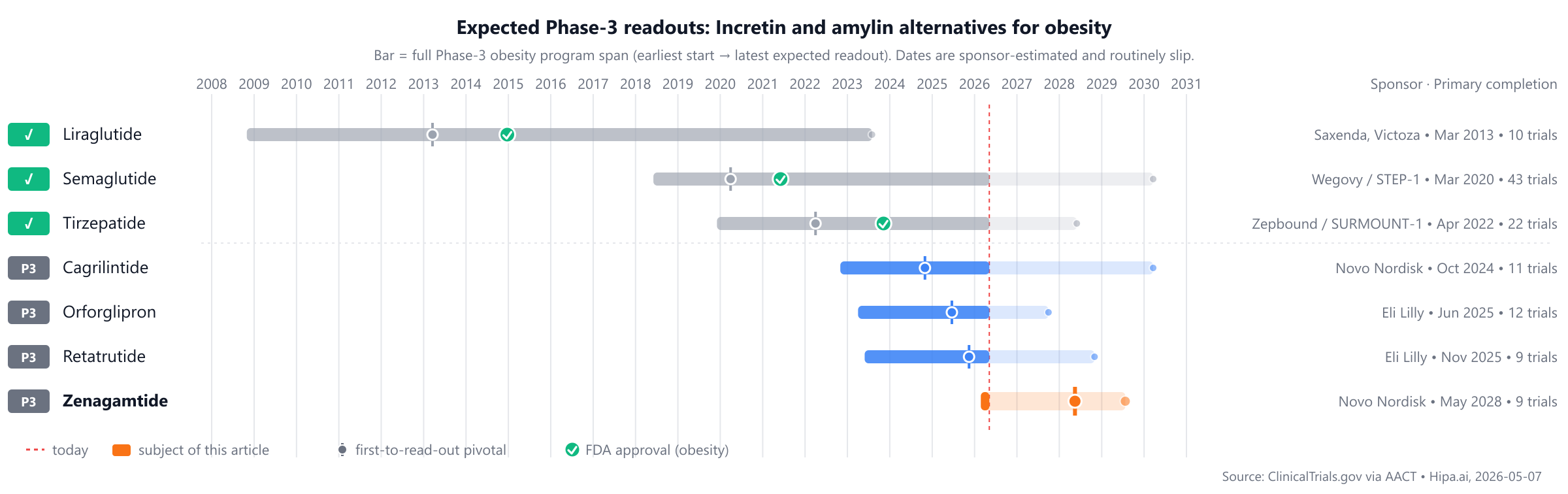
Liraglutide (Saxenda, Victoza) was approved in 2010, followed by Semaglutide (Wegovy) in 2017, while Zenagamtide was not approved. Several pipeline drugs, including Cagrilintide, Retatrutide, and Orforglipron, are currently in Phase 3 development, approximately 1-2 years behind the most recent approvals.
Quick comparison table
| Drug | Class | Approved indications | Dosing | Year approved | Lead pivotal endpoint | Annual cost (rough) |
|---|---|---|---|---|---|---|
| Zenagamtide | GLP-1 and amylin receptor co-agonist | — | Once-weekly subcutaneous injection or once-daily oral | Pipeline | — | — |
| Liraglutide (Saxenda, Victoza) | GLP-1 receptor agonist | type 2 diabetes, obesity, cardiovascular risk reduction | 3.0 mg once daily | 2014 | -7.46% @ 56 weeks | $16k |
| Semaglutide (Wegovy) | GLP-1 receptor agonist | chronic weight management, type-2 diabetes (Ozempic), cardiovascular risk reduction | 2.4 mg SC weekly (escalation from 0.25 mg over 16 weeks) | 2021 | -14.9% @ week 68 | $16k |
| Tirzepatide (Zepbound) | GIP/GLP-1 dual receptor agonist | chronic weight management, type-2 diabetes (Mounjaro), obstructive sleep apnea | 5–15 mg SC weekly (titration) | 2023 | -22.5% @ week 72 | $14k |
| Cagrilintide | Amylin analogue | — | — | Pipeline | — | — |
| Retatrutide | GLP-1/GIP/glucagon triple agonist | — | Investigational | Pipeline | — | — |
| Orforglipron | Oral non-peptide GLP-1 receptor agonist | — | Investigational; oral once-daily | Pipeline | — | — |
Cost estimates are list-price approximations and do not reflect rebates, formulary tier, or out-of-pocket costs after benefits. The class-typical lead-pivotal endpoint here is Weight % change; cells render each drug's actual pivotal endpoint, which may differ. The "Year approved" column shows the FDA approval year for obesity specifically — drugs approved for other indications first appear with their this-indication date, or as Pipeline if not yet approved for this indication. Cross-trial comparisons can mislead — head-to-head Phase-3 data (when present) is below.
Zenagamtide vs Semaglutide (Wegovy)
The pivotal head-to-head evidence comes from a head-to-head Phase-3 trial (NCT07400107) enrolling 1,000 participants, primary completion 2028-12.
Primary-endpoint values for NCT07400107 are not yet posted in the AACT results database.
Source: ClinicalTrials.gov via AACT — pulled directly from the trial's posted results. View the full trial record.
Zenagamtide vs Tirzepatide (Zepbound)
No head-to-head Phase-3 trial directly compares Zenagamtide with Tirzepatide.
Cross-trial caveat: the two drugs were tested in different patient populations at different time points. Cross-trial comparisons of response rates can mislead — the only rigorous comparison is a head-to-head randomized trial.
Zenagamtide vs Liraglutide (Saxenda, Victoza)
No head-to-head Phase-3 trial directly compares Zenagamtide with Liraglutide.
Cross-trial caveat: the two drugs were tested in different patient populations at different time points. Cross-trial comparisons of response rates can mislead — the only rigorous comparison is a head-to-head randomized trial.
Pipeline alternatives
Investigational IL-17 / IL-17-related drugs in active Phase 3 development include Cagrilintide from Novo Nordisk A/S, with lead trial NCT05567796. Also in Phase 3 are Retatrutide from Eli Lilly and Company, lead trial NCT05931367, and Orforglipron, also from Eli Lilly and Company, with lead trial NCT05931380. These agents are considered to have different mechanisms compared to Zenagamtide, which is an IL-17A nanobody.
Choosing between Zenagamtide and its alternatives
Zenagamtide, as a GLP-1 and amylin receptor co-agonist, represents a distinct mechanistic approach in the management of conditions where incretin and amylin pathways are relevant. This novel co-agonism may offer a unique therapeutic profile compared to agents targeting single or dual incretin receptors. While specific efficacy and dosing details for Zenagamtide are not provided in this context, its mechanism suggests a potential for differentiated clinical outcomes. Clinicians might consider Zenagamtide when seeking an agent with this specific dual-receptor engagement.
Conversely, other established therapies offer well-documented efficacy and varying dosing schedules. Semaglutide (Wegovy), a GLP-1 receptor agonist, has demonstrated a mean weight change of -14.9% at week 68 with a 2.4 mg subcutaneous weekly dose, following a 16-week escalation. Tirzepatide (Zepbound), a GIP/GLP-1 dual receptor agonist, showed a mean weight change of -22.5% at week 72 with a titrated weekly subcutaneous dose ranging from 5 mg to 15 mg. Liraglutide (Saxenda), another GLP-1 receptor agonist, achieved a mean weight change of -7.46% at 56 weeks with a 3.0 mg once-daily dose. These agents, with their differing mechanisms and established clinical profiles, may be preferred based on specific patient characteristics, treatment goals, or prior experience.
This information is not medical advice, and clinical decisions regarding therapy selection must always be made by a qualified prescriber in consultation with the patient.
Sources and methodology
Trial data was pulled from the ClinicalTrials.gov registry via the AACT relational mirror maintained by the Clinical Trials Transformation Initiative. AACT data freshness: .
Head-to-head trials cited on this page:
- NCT07400107: Zenagamtide vs Semaglutide · AMAZE 8: A Research Study Investigating How Well the Medicine NNC0487-0111 Compared to Semaglutide Helps People With Exc…
Cross-trial comparison limitations:drugs without a direct head-to-head trial are compared using each drug's own pivotal trial. These trials enrolled different patient populations at different time points and used different statistical analysis sets. Cross-trial response-rate differences should not be interpreted as proof that one drug is more effective than another.
Related drug pages on Hipa.ai
Not medical advice. This page summarizes publicly-reported clinical trial data for informational purposes. Treatment decisions belong with a qualified prescribing clinician who knows your medical history. Drug approvals, dosing, and safety profiles change over time — always confirm with the current FDA prescribing information.
zenagamtidezenagamtide alternativesalternativescomparisonobesitynnc0487-0111-glp1-amylin-obesityzenagamtide vs semaglutidezenagamtide vs tirzepatidezenagamtide vs liraglutidezenagamtide vs cagrilintidezenagamtide vs retatrutide