KAI-9531 is a novel GLP-1/GIP dual agonist, representing an evolving class of medications. This page provides a comparison of KAI-9531 with established treatments like semaglutide (Wegovy) and tirzepatide (Zepbound). Its dual receptor agonism offers a distinct pharmacological approach compared to some single-receptor agonists.
KAI-9531 Alternatives: How It Compares to Other GLP-1 Drugs
Hipa.ai Research · Source: ClinicalTrials.gov / AACT · Last updated: Verified data · 10/10 curated
Source: ClinicalTrials.gov via AACT · Hipa.ai, 2026-05-07Download chart as PNG
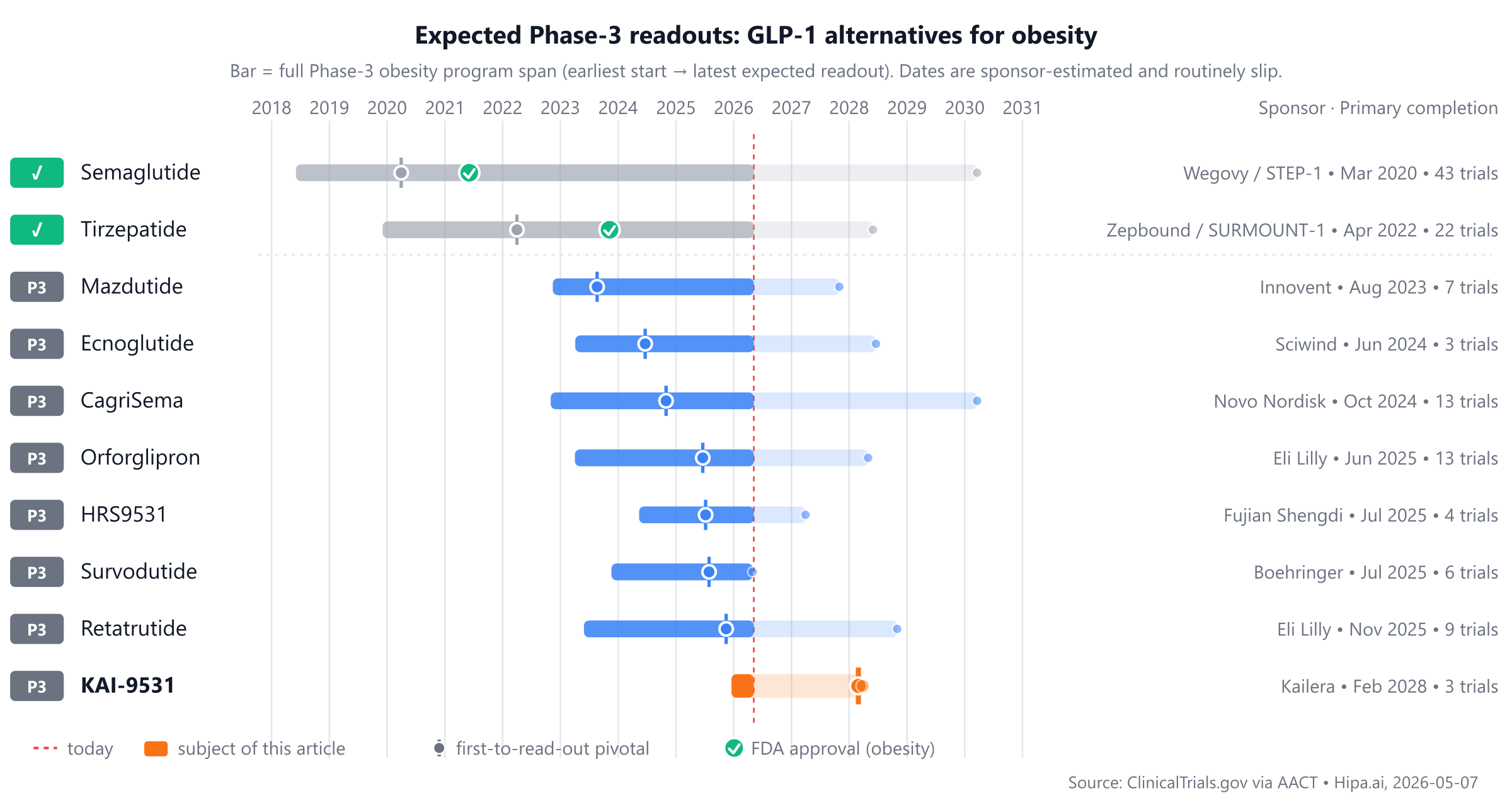
The competitive landscape includes approved comparators such as Semaglutide (Wegovy) from 2017 and Tirzepatide (Zepbound) from 2022. KAI-9531's approval date is not yet available, while numerous other drugs including Mazdutide, CagriSema, and Retatrutide are currently in Phase 3, potentially 1-2 years behind the most recent market entrants.
Quick comparison table
| Drug | Class | Approved indications | Dosing | Year approved | Lead pivotal endpoint | Annual cost (rough) |
|---|---|---|---|---|---|---|
| KAI-9531 | GLP-1/GIP dual agonist | — | Investigational; Phase-3 obesity | Pipeline | — | — |
| Semaglutide (Wegovy) | GLP-1 receptor agonist | chronic weight management, type-2 diabetes (Ozempic), cardiovascular risk reduction | 2.4 mg SC weekly (escalation from 0.25 mg over 16 weeks) | 2021 | -14.9% @ week 68 | $16k |
| Tirzepatide (Zepbound) | GIP/GLP-1 dual receptor agonist | chronic weight management, type-2 diabetes (Mounjaro), obstructive sleep apnea | 5–15 mg SC weekly (titration) | 2023 | -22.5% @ week 72 | $14k |
| Mazdutide | GLP-1/glucagon dual agonist | — | Investigational | Pipeline | — | — |
| CagriSema | Cagrilintide + Semaglutide combination | — | Investigational | Pipeline | — | — |
| Ecnoglutide | GLP-1 receptor agonist | — | Investigational | Pipeline | — | — |
| Orforglipron | Oral non-peptide GLP-1 receptor agonist | — | Investigational; oral once-daily | Pipeline | — | — |
| HRS9531 | GLP-1/GIP dual agonist | — | Investigational | Pipeline | — | — |
| Retatrutide | GLP-1/GIP/glucagon triple agonist | — | Investigational | Pipeline | — | — |
| Survodutide | GLP-1/glucagon dual agonist | — | Investigational | Pipeline | — | — |
Cost estimates are list-price approximations and do not reflect rebates, formulary tier, or out-of-pocket costs after benefits. The class-typical lead-pivotal endpoint here is Weight % change; cells render each drug's actual pivotal endpoint, which may differ. The "Year approved" column shows the FDA approval year for obesity specifically — drugs approved for other indications first appear with their this-indication date, or as Pipeline if not yet approved for this indication. Cross-trial comparisons can mislead — head-to-head Phase-3 data (when present) is below.
KAI-9531 vs Semaglutide (Wegovy)
The pivotal head-to-head evidence comes from a head-to-head Phase-3 trial (NCT07284979) enrolling 1,200 participants, primary completion 2028-03.
Primary-endpoint values for NCT07284979 are not yet posted in the AACT results database.
Source: ClinicalTrials.gov via AACT — pulled directly from the trial's posted results. View the full trial record.
KAI-9531 vs Tirzepatide (Zepbound)
No head-to-head Phase-3 trial directly compares KAI-9531 with Tirzepatide.
Cross-trial caveat: the two drugs were tested in different patient populations at different time points. Cross-trial comparisons of response rates can mislead — the only rigorous comparison is a head-to-head randomized trial.
Pipeline alternatives
A number of investigational drugs are currently in active Phase 3 development. These include Mazdutide from Innovent Biologics (Suzhou) Co. Ltd., with its lead trial NCT05607680; CagriSema by Novo Nordisk A/S, with lead trial NCT05567796; Ecnoglutide from Hangzhou Sciwind Biosciences Co., Ltd., lead trial NCT05813795; Orforglipron from Eli Lilly and Company, lead trial NCT05931380; HRS9531 by Fujian Shengdi Pharmaceutical Co., Ltd., lead trial NCT06396429; Retatrutide from Eli Lilly and Company, lead trial NCT05931367; and Survodutide by Boehringer Ingelheim, lead trial NCT06214741.
Choosing between KAI-9531 and its alternatives
When considering KAI-9531, clinicians may weigh its mechanism as a GLP-1/GIP dual agonist, a class of agents that has shown substantial efficacy in weight management. This dual agonism targets both glucagon-like peptide-1 (GLP-1) and glucose-dependent insulinotropic polypeptide (GIP) receptors, which may offer a comprehensive approach to metabolic regulation compared to GLP-1 receptor agonists alone. For instance, in clinical trials, the GLP-1 receptor agonist semaglutide (Wegovy) demonstrated a mean weight reduction of -14.9% at week 68, while the GIP/GLP-1 dual receptor agonist tirzepatide (Zepbound) showed a mean weight reduction of -22.5% at week 72. While specific efficacy data for KAI-9531 is not detailed here, its dual mechanism positions it within this potentially highly effective therapeutic class.
Conversely, clinicians might opt for established alternatives such as semaglutide (Wegovy) or tirzepatide (Zepbound) in certain clinical scenarios. These agents have a longer history of clinical use, providing a more extensive real-world safety and efficacy profile. Semaglutide, administered as 2.4 mg SC weekly (with escalation over 16 weeks), and tirzepatide, with its 5–15 mg SC weekly titration, offer well-defined dosing regimens that are familiar to prescribers. The choice between these options and KAI-9531 may also depend on patient-specific factors, including individual response to different mechanisms of action or tolerability profiles.
This information is for educational purposes only and does not constitute medical advice; all clinical decisions regarding patient care should be made by a qualified healthcare professional.
Sources and methodology
Trial data was pulled from the ClinicalTrials.gov registry via the AACT relational mirror maintained by the Clinical Trials Transformation Initiative. AACT data freshness: .
Head-to-head trials cited on this page:
- NCT07284979: KAI-9531 vs Semaglutide · Efficacy and Safety of KAI-9531 Administered Once Weekly Compared With Semaglutide and Placebo in Participants Living Wi…
Cross-trial comparison limitations:drugs without a direct head-to-head trial are compared using each drug's own pivotal trial. These trials enrolled different patient populations at different time points and used different statistical analysis sets. Cross-trial response-rate differences should not be interpreted as proof that one drug is more effective than another.
Related drug pages on Hipa.ai
Not medical advice. This page summarizes publicly-reported clinical trial data for informational purposes. Treatment decisions belong with a qualified prescribing clinician who knows your medical history. Drug approvals, dosing, and safety profiles change over time — always confirm with the current FDA prescribing information.
kai-9531kai-9531 alternativesalternativescomparisonobesityglp1-obesitykai-9531 vs semaglutidekai-9531 vs tirzepatidekai-9531 vs mazdutidekai-9531 vs cagrisemakai-9531 vs ecnoglutide