Epcoritamab is a CD20xCD3 bispecific antibody approved for the treatment of diffuse large B-cell lymphoma, high-grade B-cell lymphoma, and follicular lymphoma. This page compares Epcoritamab to other agents in its class, including Glofitamab (Columvi) and Obinutuzumab (Gazyva). While sharing a common target, these therapies differ in their mechanisms and administration schedules.
Epcoritamab Alternatives: How It Compares to Other CD20-Targeted Therapies
Hipa.ai Research · Source: ClinicalTrials.gov / AACT · Last updated: Limited data · 0/5 curated
Source: ClinicalTrials.gov via AACT · Hipa.ai, 2026-05-07Download chart as PNG
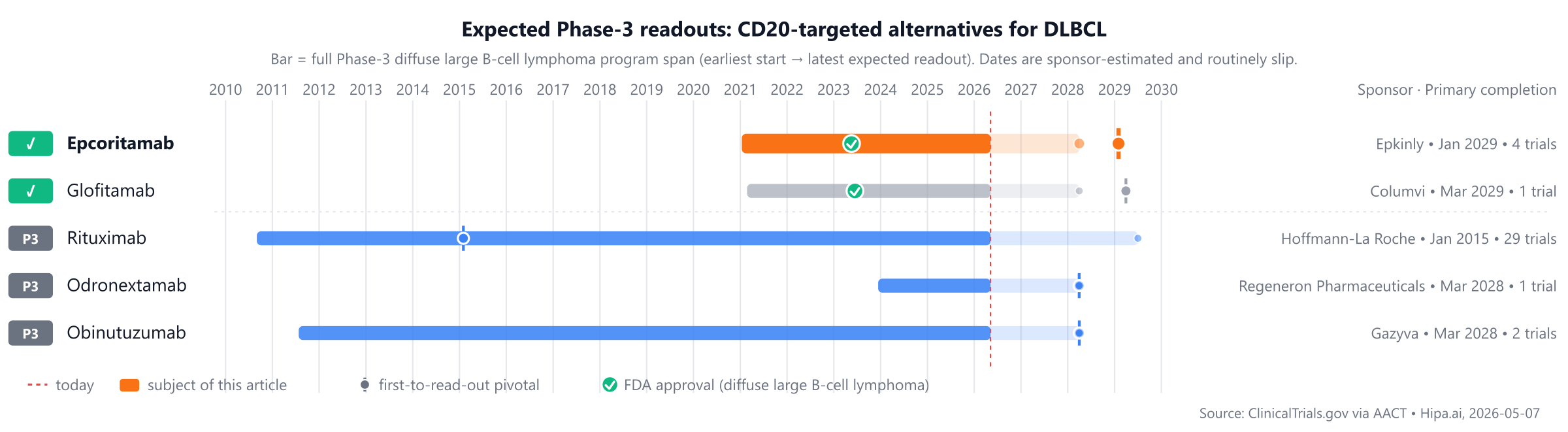
Obinutuzumab (Gazyva) was approved in 2013, followed by Epcoritamab and Glofitamab (Columvi) in 2023. Rituximab, Obinutuzumab, and Odronextamab are currently in Phase 3 development, approximately 1-2 years behind these approved therapies.
Quick comparison table
| Drug | Class | Approved indications | Dosing | Year approved | Lead pivotal endpoint | Annual cost (rough) |
|---|---|---|---|---|---|---|
| Epcoritamab (Epkinly) | CD20xCD3 bispecific antibody | diffuse large B-cell lymphoma, high-grade B-cell lymphoma, follicular lymphoma | Subcutaneous injection in 28-day cycles (step-up dosing in Cycle 1, followed by 48 mg weekly, then every 2 to 4 weeks) | 2023 | overall response rate: 61% @ median follow-up of 9.8 months | $450k |
| Glofitamab (Columvi) | Bispecific T-cell engager | Relapsed or refractory diffuse large B-cell lymphoma (DLBCL), Large B-cell lymphoma (LBCL) arising from follicular lymphoma | Cycle 1: obinutuzumab pretreatment Day 1, glofitamab 2.5 mg IV Day 8, 10 mg IV Day 15. Cycles 2-12: 30 mg IV Day 1. Cycles are 21 days (maximum 12 cycles). | 2023 | 56% @ 11.6 months | $142k |
| Rituximab | — | — | — | Pipeline | — | — |
| Obinutuzumab (Gazyva) | Anti-CD20 monoclonal antibody | chronic lymphocytic leukemia, follicular lymphoma, lupus nephritis | 1000 mg IV on Days 1, 8, and 15 of Cycle 1, followed by 1000 mg IV on Day 1 of subsequent cycles. Maintenance dosing is 1000 mg every 2 months for up to 2 years. | Pipeline | — | $74k |
| Odronextamab | — | — | — | Pipeline | — | — |
Cost estimates are list-price approximations and do not reflect rebates, formulary tier, or out-of-pocket costs after benefits. The class-typical lead-pivotal endpoint here is Objective Response Rate (ORR); cells render each drug's actual pivotal endpoint, which may differ. The "Year approved" column shows the FDA approval year for diffuse large B-cell lymphoma specifically — drugs approved for other indications first appear with their this-indication date, or as Pipeline if not yet approved for this indication. Cross-trial comparisons can mislead — head-to-head Phase-3 data (when present) is below.
Epcoritamab vs Glofitamab (Columvi)
No head-to-head Phase-3 trial directly compares Epcoritamab with Glofitamab.
In separate pivotal trials, Epcoritamab reported 61% overall response rate at median follow-up of 9.8 months (NCT03625037) versus 56% ORR at 11.6 months for Glofitamab (NCT03075696).
Cross-trial caveat: the two drugs were tested in different patient populations at different time points. Cross-trial comparisons of response rates can mislead — the only rigorous comparison is a head-to-head randomized trial.
Epcoritamab vs Obinutuzumab (Gazyva)
The pivotal head-to-head evidence comes from a head-to-head Phase-3 trial (NCT06191744) enrolling 1,095 participants, primary completion 2037-11.
Primary-endpoint values for NCT06191744 are not yet posted in the AACT results database.
Source: ClinicalTrials.gov via AACT — pulled directly from the trial's posted results. View the full trial record.
Pipeline alternatives
Several investigational agents are currently in active Phase 3 development. These include Rituximab from Hoffmann-La Roche, with its lead Phase 3 trial identified as NCT01724021. Also from Hoffmann-La Roche is Obinutuzumab, which is being evaluated in a lead Phase 3 trial, NCT04408638. Regeneron Pharmaceuticals is developing Odronextamab, with its lead Phase 3 study listed as NCT06091865.
In relation to Epcoritamab, Rituximab and Obinutuzumab represent different mechanistic approaches as anti-CD20 monoclonal antibodies. Odronextamab, however, shares a similar bispecific antibody mechanism targeting CD3 and CD20, akin to Epcoritamab.
Choosing between Epcoritamab and its alternatives
Epcoritamab, as a CD20xCD3 bispecific antibody, offers a distinct mechanism of action by directly engaging T-cells to target CD20-expressing cells. Its subcutaneous administration may provide a convenience advantage over intravenous options such as glofitamab and obinutuzumab, potentially reducing clinic time for patients. While specific efficacy data for epcoritamab are not provided in this context, glofitamab, another bispecific T-cell engager, demonstrated an overall response rate (ORR) of 56% at 11.6 months in its studies.
Conversely, other CD20-targeted therapies may be preferred in certain clinical scenarios. Obinutuzumab (Gazyva), an anti-CD20 monoclonal antibody, has a longer clinical track record and a well-established safety profile, making it a familiar option for many prescribers. Its dosing regimen involves 1000 mg IV on Days 1, 8, and 15 of Cycle 1, followed by 1000 mg IV on Day 1 of subsequent cycles, with maintenance dosing every 2 months for up to 2 years. Glofitamab (Columvi), also a bispecific T-cell engager, follows a different intravenous dosing schedule, starting with obinutuzumab pretreatment on Day 1 of Cycle 1, then glofitamab 2.5 mg IV on Day 8 and 10 mg IV on Day 15, progressing to 30 mg IV on Day 1 of Cycles 2-12, with cycles lasting 21 days for a maximum of 12 cycles. These differences in mechanism and administration route may lead to distinct safety profiles and patient experiences, influencing treatment selection based on individual patient characteristics and comorbidities.
This information is for educational purposes only and does not constitute medical advice; clinical decisions regarding patient care belong with the prescriber.
Sources and methodology
Trial data was pulled from the ClinicalTrials.gov registry via the AACT relational mirror maintained by the Clinical Trials Transformation Initiative. AACT data freshness: .
Head-to-head trials cited on this page:
- NCT06191744: Epcoritamab vs Rituximab · Study of Subcutaneous Epcoritamab in Combination With Intravenous Rituximab and Oral Lenalidomide (R2) to Assess Adverse…
- NCT06191744: Epcoritamab vs Obinutuzumab · Study of Subcutaneous Epcoritamab in Combination With Intravenous Rituximab and Oral Lenalidomide (R2) to Assess Adverse…
Cross-trial comparison limitations:drugs without a direct head-to-head trial are compared using each drug's own pivotal trial. These trials enrolled different patient populations at different time points and used different statistical analysis sets. Cross-trial response-rate differences should not be interpreted as proof that one drug is more effective than another.
Related drug pages on Hipa.ai
Not medical advice. This page summarizes publicly-reported clinical trial data for informational purposes. Treatment decisions belong with a qualified prescribing clinician who knows your medical history. Drug approvals, dosing, and safety profiles change over time — always confirm with the current FDA prescribing information.
epcoritamabepcoritamab alternativesalternativescomparisondiffuse large B-cell lymphomaepcoritamab-cd20xcd3-dlbclepcoritamab vs glofitamabepcoritamab vs rituximabepcoritamab vs obinutuzumabepcoritamab vs odronextamab