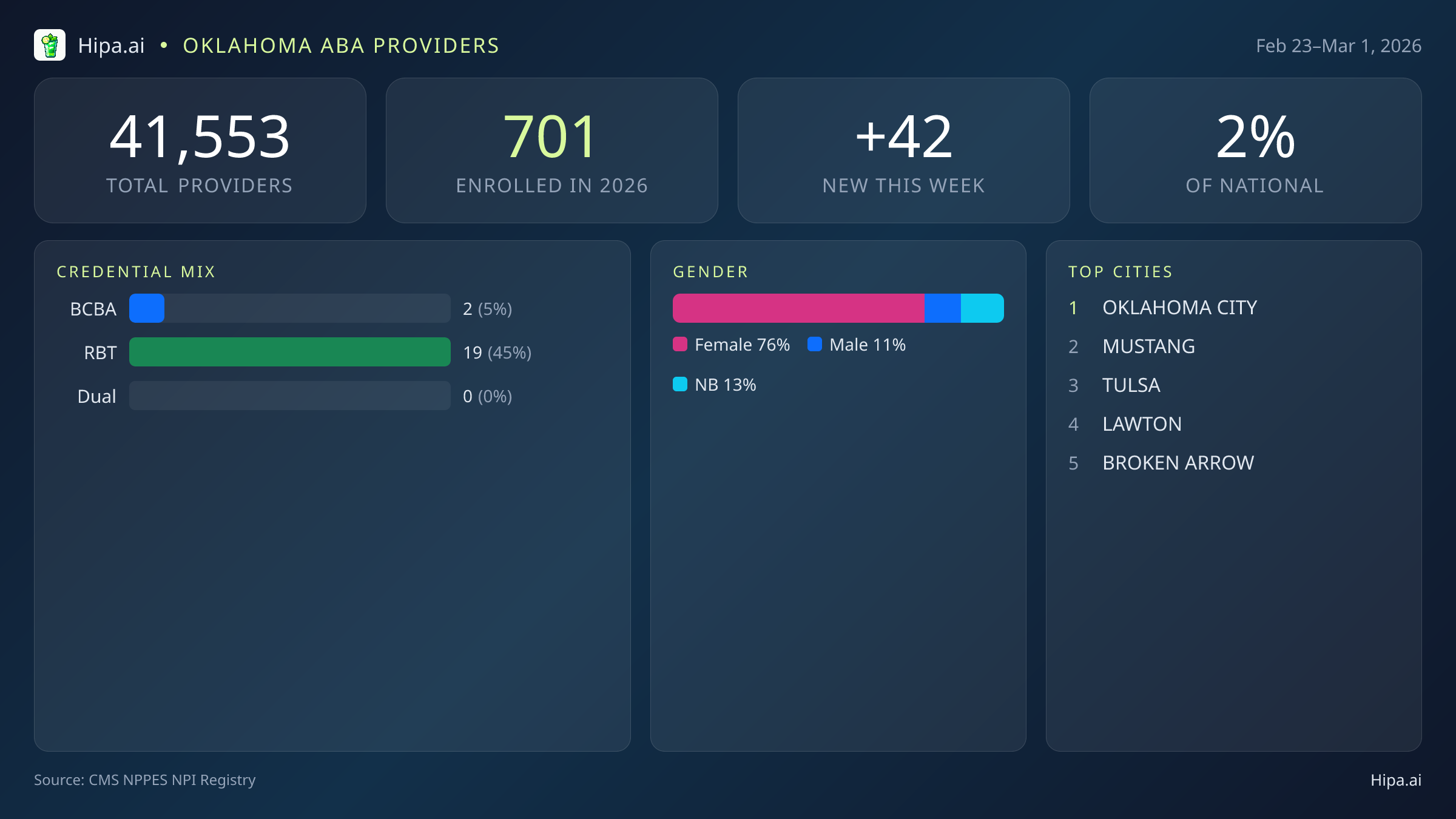
Oklahoma saw an addition of 42 behavioral health providers in the latest CMS NPI registry update, representing 1% of the national weekly total. All 42 providers were new enrollments this week, indicating a consistent, albeit smaller, influx of professionals into the state's healthcare landscape. This modest share suggests a steady, rather than rapid, expansion of the behavioral health workforce in Oklahoma.
ABA Workforce Composition
Focusing on the applied behavior analysis sector, the data shows 19 providers identified with an RBT taxonomy and 2 providers with a BCBA taxonomy. These numbers reflect specific professional designations, which can stem from either the provider's primary taxonomy or explicit credential listings. For example, 3 individuals within the RBT group also explicitly list RBT as a credential. There were no providers identified with dual BCBA and RBT credentials in this update. The resulting ratio of RBTs to BCBAs, approximately 9.5 to 1, suggests a significant number of direct service providers relative to supervisors, which is higher than typical optimal ratios and could indicate a need for more BCBA-level supervision capacity.
Provider Demographics
Among the 38 individual providers, the workforce is predominantly female, with 29 individuals, or 76%, identifying as female. Male providers account for 4 individuals, or 11%, while 5 individuals, representing 13%, identify as nonbinary. No specific organizations appeared multiple times in this week's data, suggesting a diverse range of smaller practices or individual practitioners rather than dominant multi-state chains.
This week's data, particularly the high RBT-to-BCBA ratio and the absence of dual-credentialed professionals, suggests that while Oklahoma is adding direct service capacity, there may be an increasing demand for BCBA-level supervision to support the growing RBT workforce and ensure quality ABA service delivery.