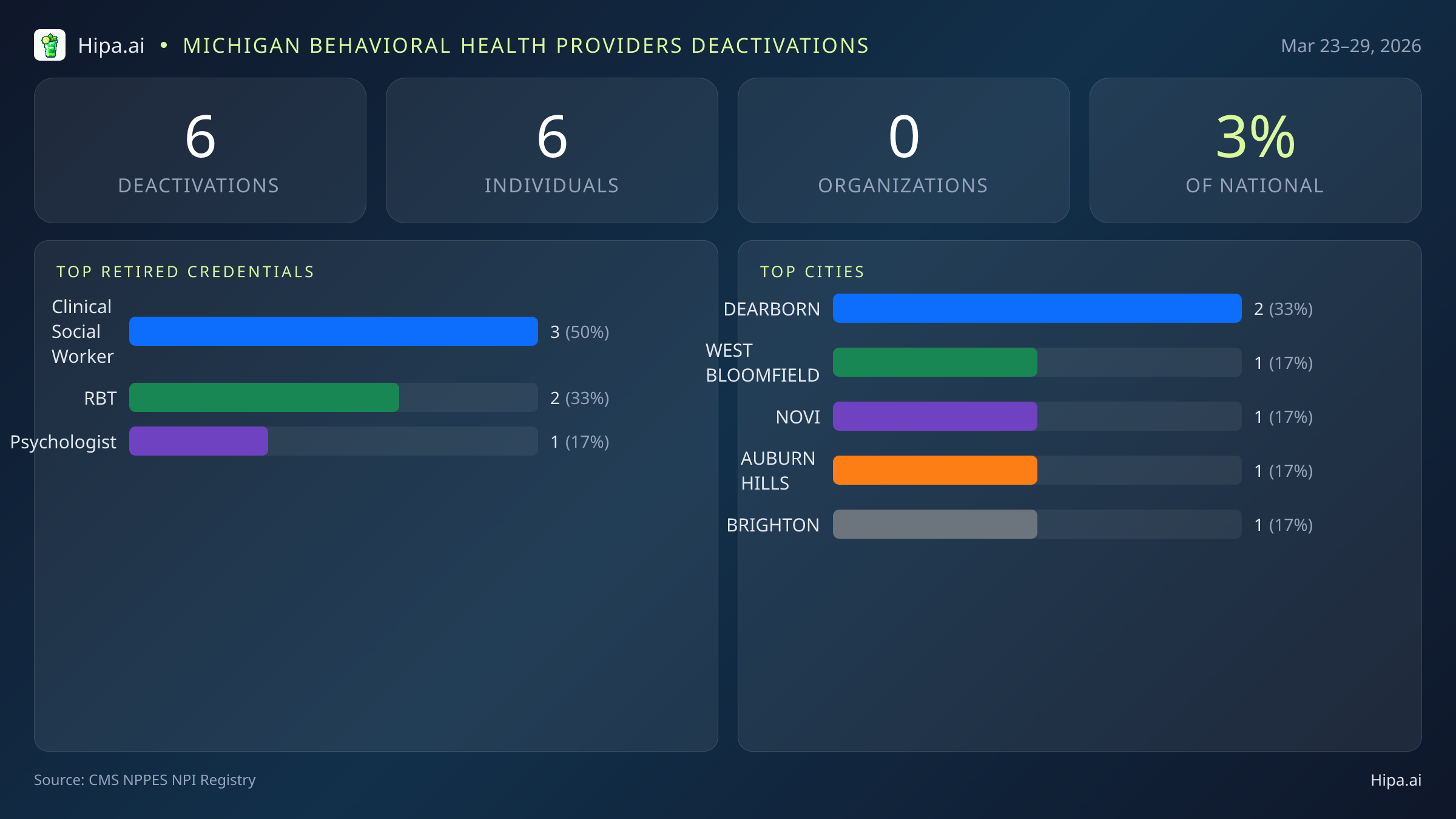
This week, Michigan recorded 6 behavioral health provider NPI deactivations, accounting for 3% of the national total. All 6 deactivations were associated with individual providers, with no organizational NPIs deactivated during this period. This data offers a snapshot of administrative changes within the state's behavioral health workforce.
Credential and Geographic Overview
Among the individual NPIs deactivated, Clinical Social Workers represented the largest group, with 3 deactivations, making up 50% of the total. Registered Behavior Technicians (RBTs) followed with 2 deactivations, comprising 33% of the week's total, while 1 Psychologist NPI was also deactivated, accounting for 17%. This distribution highlights deactivations across key therapeutic and support roles within behavioral health. Geographically, 2 deactivations were recorded in Dearborn. Single deactivations occurred in West Bloomfield, Novi, Auburn Hills, and Brighton, indicating a spread across both suburban and urban areas of Michigan rather than a single concentrated location.
Understanding NPI Deactivations
An NPI deactivation is an administrative status change in the federal NPPES registry. This status change does not inherently indicate a license action or that a provider has stopped practicing. Providers may deactivate their NPI for various reasons, including retirement, relocation, or a change in practice status. Hipa.ai retains a name cache from public CMS files captured before deactivation for historical record-keeping, providing context for these administrative updates.