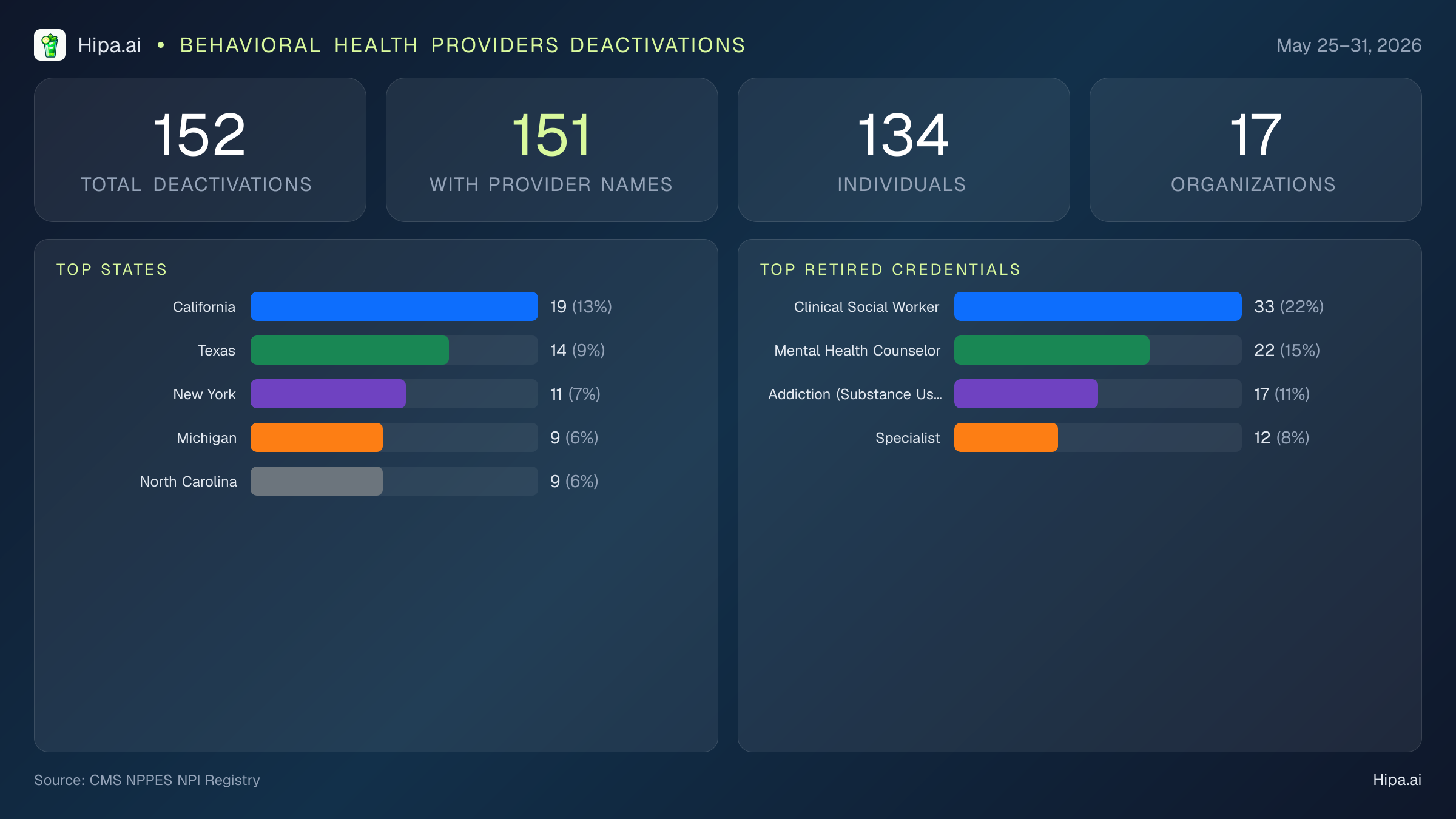
The CMS National Plan and Provider Enumeration System (NPPES) public registry recorded 152 deactivations among behavioral health provider NPIs this week, covering May 25-31, 2026. Of these, Hipa.ai's name cache captured names for 151 records before CMS privacy policies removed identifying information, indicating that one record was scrubbed. Individuals accounted for 134 deactivations, while 17 organizations also had their NPIs deactivated. California led all states, with 19 deactivations representing 13% of the national total.
Geographic Distribution of Deactivations
Beyond California's leading 19 deactivations, other populous states also saw notable activity. Texas recorded 14 deactivations, making up 9% of the total, followed by New York with 11 deactivations, or 7%. Michigan and North Carolina each reported 9 deactivations, both accounting for 6% of the week's total. Ohio had 8 deactivations (5%), and Florida registered 7 deactivations (5%). This geographic spread often reflects the distribution of the overall healthcare workforce and the natural administrative churn within the registry.
Credential and Taxonomy Insights
An analysis of the primary taxonomies among the named deactivated providers reveals the diverse roles within behavioral health. Clinical Social Workers represented the largest group, with 33 deactivations, or 22%. Mental Health Counselors followed with 22 deactivations (15%), and Addiction (Substance Use Disorder) Counselors accounted for 17 deactivations (11%). Other significant categories included Specialist, with 12 deactivations (8%), and Registered Behavior Technicians (RBTs), with 11 deactivations (7%). Case Manager/Care Coordinator roles also saw 10 deactivations, comprising 7% of the named total.
Contextualizing NPI Deactivations
NPI deactivations are administrative status changes within the federal NPPES registry. They do not inherently signify a license action, malpractice, or that a provider has ceased practicing. Providers may obtain new NPIs, retire, change their entity type, or have their records retired for clerical reasons. The observed deactivations are a routine aspect of registry maintenance and reflect the ongoing administrative dynamics of the U.S. healthcare workforce.