Teclistamab is a BCMA-directed CD3 bispecific T-cell engager approved for relapsed or refractory multiple myeloma. This page compares Teclistamab to other agents, including Elranatamab (Elrexfio), Linvoseltamab (Lynozyfic), and Cilta-cel (Carvykti), highlighting differences in their administration schedules and specific mechanisms of action.
Teclistamab Alternatives: How It Compares to Other BCMA-Targeted Therapies
Hipa.ai Research · Source: ClinicalTrials.gov / AACT · Last updated: Limited data · 0/6 curated
Source: ClinicalTrials.gov via AACT · Hipa.ai, 2026-05-07Download chart as PNG
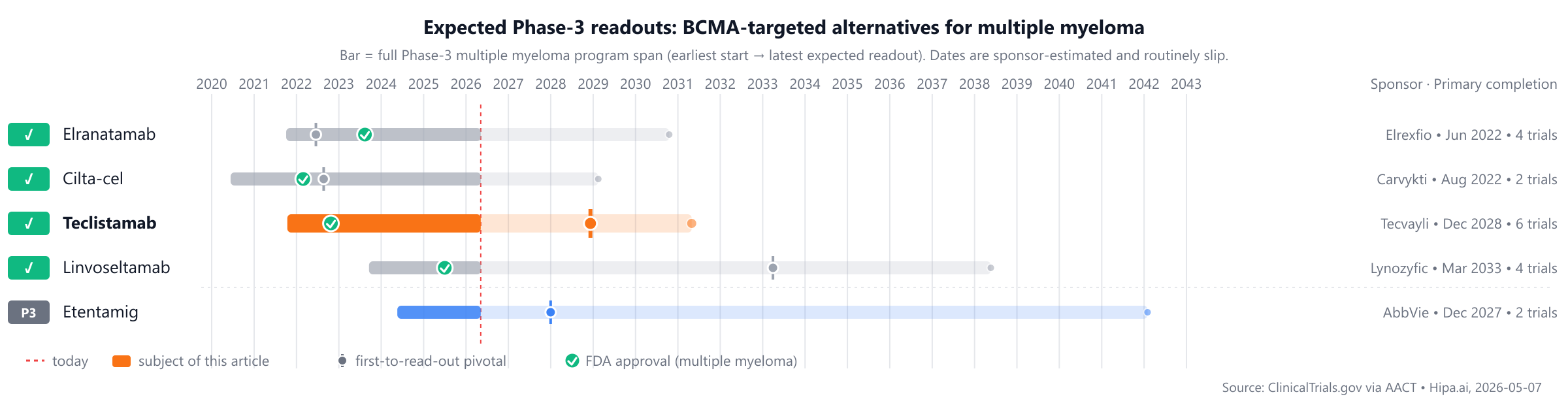
The competitive landscape includes approved therapies like Cilta-cel (Carvykti) from 2022 and Elranatamab (Elrexfio) from 2023, with Teclistamab also approved in 2022. Several drugs, including Belantamab-mafodotin and Etentamig, remain in Phase 3, approximately 1-2 years behind the earliest approvals.
Quick comparison table
| Drug | Class | Approved indications | Dosing | Year approved | Lead pivotal endpoint | Annual cost (rough) |
|---|---|---|---|---|---|---|
| Teclistamab (Tecvayli) | BCMA-directed CD3 bispecific T-cell engager | relapsed or refractory multiple myeloma | Step-up doses of 0.06 mg/kg and 0.3 mg/kg, followed by 1.5 mg/kg subcutaneously once weekly until disease progression or unacceptable toxicity (may be reduced to biweekly or monthly in responding patients) | 2022 | 89% @ 34.5 months | $474k |
| Cilta-cel (Carvykti) | BCMA-directed CAR-T cell therapy | multiple myeloma | Single intravenous infusion of 0.5-1.0 x 10^6 CAR-positive viable T cells/kg (maximum 1 x 10^8 cells) | 2022 | 97.9% @ 18 months | $465k |
| Elranatamab (Elrexfio) | BCMA-directed CD3 bispecific antibody | Multiple myeloma | Step-up doses of 12 mg on Day 1 and 32 mg on Day 4, followed by 76 mg subcutaneously once weekly starting on Day 8 through Week 24. After 24 weeks, responders may transition to 76 mg every 2 weeks, and subsequently every 4 weeks if response is maintained. | 2023 | 57.7% @ 11.1 months median follow-up | $330k |
| Linvoseltamab (Lynozyfic) | BCMAxCD3 bispecific antibody | Relapsed or refractory multiple myeloma | Intravenous infusion: 5 mg on day 1, 25 mg on day 8, 200 mg on day 15; then 200 mg weekly (weeks 4-13), every 2 weeks (weeks 14-24), and every 4 weeks thereafter (if VGPR or better is achieved). | 2025 | 70% @ median 13 months | $454k |
| Belantamab-mafodotin | — | — | — | Pipeline | — | — |
| Etentamig | BCMA-directed bispecific T-cell engager | — | 60 mg intravenously every 4 weeks | Pipeline | — | — |
Cost estimates are list-price approximations and do not reflect rebates, formulary tier, or out-of-pocket costs after benefits. The class-typical lead-pivotal endpoint here is ORR; cells render each drug's actual pivotal endpoint, which may differ. The "Year approved" column shows the FDA approval year for multiple myeloma specifically — drugs approved for other indications first appear with their this-indication date, or as Pipeline if not yet approved for this indication. Cross-trial comparisons can mislead — head-to-head Phase-3 data (when present) is below.
Teclistamab vs Elranatamab (Elrexfio)
No head-to-head Phase-3 trial directly compares Teclistamab with Elranatamab.
In separate pivotal trials, Teclistamab reported 89% ORR at 34.5 months (NCT05083169) versus 57.7% ORR at 11.1 months median follow-up for Elranatamab (NCT04649359).
Cross-trial caveat: the two drugs were tested in different patient populations at different time points. Cross-trial comparisons of response rates can mislead — the only rigorous comparison is a head-to-head randomized trial.
Teclistamab vs Linvoseltamab (Lynozyfic)
No head-to-head Phase-3 trial directly compares Teclistamab with Linvoseltamab.
In separate pivotal trials, Teclistamab reported 89% ORR at 34.5 months (NCT05083169) versus 70% ORR at median 13 months for Linvoseltamab (NCT03761108).
Cross-trial caveat: the two drugs were tested in different patient populations at different time points. Cross-trial comparisons of response rates can mislead — the only rigorous comparison is a head-to-head randomized trial.
Teclistamab vs Cilta-cel (Carvykti)
No head-to-head Phase-3 trial directly compares Teclistamab with Cilta-cel.
In separate pivotal trials, Teclistamab reported 89% ORR at 34.5 months (NCT05083169) versus 97.9% ORR at 18 months for Cilta-cel (NCT03548207).
Cross-trial caveat: the two drugs were tested in different patient populations at different time points. Cross-trial comparisons of response rates can mislead — the only rigorous comparison is a head-to-head randomized trial.
Pipeline alternatives
Several investigational IL-17 / IL-17-related drugs are currently in active Phase 3 development. Among these is Etentamig, from AbbVie, an IL-17A nanobody being evaluated in a lead Phase 3 trial, NCT06158841. Also in Phase 3 development is Belantamab-mafodotin, for which the sponsor is currently unknown. Both investigational agents represent different mechanisms of action compared to Teclistamab.
Choosing between Teclistamab and its alternatives
Clinicians considering BCMA-targeted therapies may find bispecific T-cell engagers like Teclistamab to be a suitable option due to their "off-the-shelf" availability. This characteristic allows for more immediate administration compared to CAR-T cell therapies such as Cilta-cel, which require individualized cell collection and manufacturing time. The bispecific T-cell engager mechanism offers a distinct approach to engaging the immune system against BCMA-expressing myeloma cells, potentially appealing when rapid treatment initiation is desired or when the logistical complexities associated with CAR-T are a significant factor.
For patients where the highest reported response rates are a primary consideration, Cilta-cel, a BCMA-directed CAR-T cell therapy, demonstrated an overall response rate (ORR) of 97.9% at a median of 18 months follow-up. This magnitude of response is notably higher than the ORRs reported for the bispecific antibodies: Linvoseltamab showed an ORR of 70% at 13 months, and Elranatamab achieved an ORR of 57.7% at 11.1 months. Among the bispecifics, the choice between Linvoseltamab and Elranatamab may involve considerations of administration route. Linvoseltamab is administered via intravenous infusion, while Elranatamab offers the potential for subcutaneous administration after initial step-up doses, transitioning to less frequent dosing schedules for responders. These differences in efficacy and administration logistics can guide treatment selection based on patient profile, treatment goals, and practical considerations. This information is not medical advice; clinical decisions belong with the prescriber.
Sources and methodology
Trial data was pulled from the ClinicalTrials.gov registry via the AACT relational mirror maintained by the Clinical Trials Transformation Initiative. AACT data freshness: .
Cross-trial comparison limitations:drugs without a direct head-to-head trial are compared using each drug's own pivotal trial. These trials enrolled different patient populations at different time points and used different statistical analysis sets. Cross-trial response-rate differences should not be interpreted as proof that one drug is more effective than another.
Related drug pages on Hipa.ai
Not medical advice. This page summarizes publicly-reported clinical trial data for informational purposes. Treatment decisions belong with a qualified prescribing clinician who knows your medical history. Drug approvals, dosing, and safety profiles change over time — always confirm with the current FDA prescribing information.
teclistamabteclistamab alternativesalternativescomparisonmultiple myelomabcma-targeted-multiple-myelomateclistamab vs elranatamabteclistamab vs linvoseltamabteclistamab vs belantamab-mafodotinteclistamab vs cilta-celteclistamab vs etentamig