Saruparib is a PARP1 inhibitor. This page compares its profile with other agents, including the PARP inhibitors Olaparib (Lynparza) and Rucaparib (Rubraca), and the androgen receptor inhibitor Enzalutamide (Xtandi). These drugs represent distinct therapeutic strategies across various oncologic indications.
Saruparib Alternatives: How It Compares to Other PARP & AR Inhibitors
Hipa.ai Research · Source: ClinicalTrials.gov / AACT · Last updated: Limited data · 0/7 curated
Source: ClinicalTrials.gov via AACT · Hipa.ai, 2026-05-07Download chart as PNG
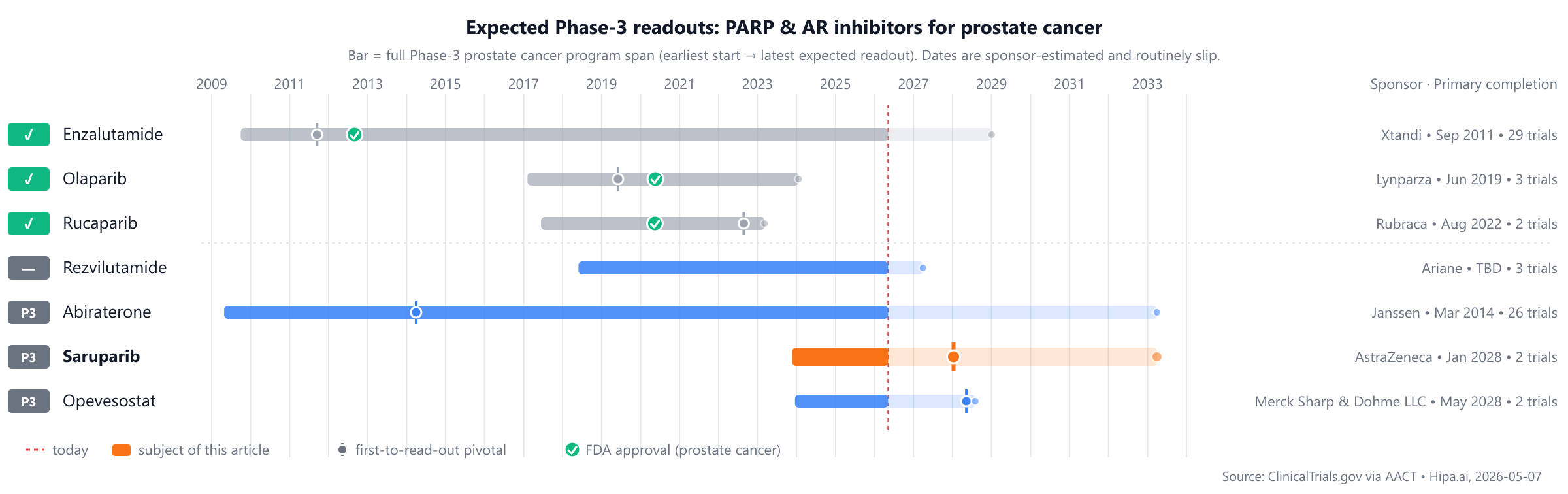
The competitive landscape includes approved comparators such as Enzalutamide (Xtandi), approved in 2012, and Olaparib (Lynparza), approved in 2014; while Saruparib is not yet approved, pipeline drugs like Abiraterone, Opevesostat, and Rezvilutamide are still in Phase 3, potentially 1-2 years behind.
Quick comparison table
| Drug | Class | Approved indications | Dosing | Year approved | Lead pivotal endpoint | Annual cost (rough) |
|---|---|---|---|---|---|---|
| Saruparib | PARP1 inhibitor | — | 60 mg once daily | Pipeline | ORR: 48.4% @ Data cutoff | — |
| Enzalutamide (Xtandi) | Androgen receptor inhibitor | prostate cancer | 160 mg orally once daily | 2012 | overall survival: 18.4months @ median | $190k |
| Rucaparib (Rubraca) | PARP inhibitor | ovarian cancer, prostate cancer | 600 mg orally twice daily | 2020 | 11.2months @ median | $175k |
| Olaparib (Lynparza) | PARP inhibitor | Ovarian cancer, Breast cancer, Pancreatic cancer, +1 more | 300 mg orally twice daily | 2020 | 7.4months @ median | $174k |
| Abiraterone | — | — | — | Pipeline | — | — |
| Opevesostat | CYP11A1 inhibitor | — | — | Pipeline | — | — |
| Rezvilutamide (Ariane) | Androgen receptor inhibitor | — | 240 mg orally once daily | Pipeline | 72.9% @ 24 months | — |
Cost estimates are list-price approximations and do not reflect rebates, formulary tier, or out-of-pocket costs after benefits. The class-typical lead-pivotal endpoint here is Radiographic progression-free survival (rPFS); cells render each drug's actual pivotal endpoint, which may differ. The "Year approved" column shows the FDA approval year for prostate cancer specifically — drugs approved for other indications first appear with their this-indication date, or as Pipeline if not yet approved for this indication. Cross-trial comparisons can mislead — head-to-head Phase-3 data (when present) is below.
Saruparib vs Olaparib (Lynparza)
No head-to-head Phase-3 trial directly compares Saruparib with Olaparib.
In separate pivotal trials, Saruparib reported 48.4% ORR at Data cutoff (NCT04644068) versus 7.4months radiographic progression-free survival (rPFS) at median for Olaparib (NCT02987543).
Cross-trial caveat: the two drugs were tested in different patient populations at different time points. Cross-trial comparisons of response rates can mislead — the only rigorous comparison is a head-to-head randomized trial.
Saruparib vs Rucaparib (Rubraca)
No head-to-head Phase-3 trial directly compares Saruparib with Rucaparib.
In separate pivotal trials, Saruparib reported 48.4% ORR at Data cutoff (NCT04644068) versus 11.2months rPFS at median for Rucaparib (NCT02975934).
Cross-trial caveat: the two drugs were tested in different patient populations at different time points. Cross-trial comparisons of response rates can mislead — the only rigorous comparison is a head-to-head randomized trial.
Saruparib vs Enzalutamide (Xtandi)
The pivotal head-to-head evidence comes from a head-to-head Phase-3 trial (NCT06120491) enrolling 1,800 participants, primary completion 2028-01.
Primary-endpoint values for NCT06120491 are not yet posted in the AACT results database.
Source: ClinicalTrials.gov via AACT — pulled directly from the trial's posted results. View the full trial record.
Pipeline alternatives
Several investigational agents are currently in active Phase 3 clinical development as potential IL-17 or IL-17-related therapies. Among these is Opevesostat, an IL-17A nanobody from Merck Sharp & Dohme LLC, with its lead Phase 3 trial identified as NCT06136650. Also in Phase 3 is Abiraterone, developed by Janssen Research & Development, LLC, with a key study listed under NCT00887198. Additionally, Rezvilutamide is another investigational agent in Phase 3 development, though its sponsor is not specified in the available data.
Choosing between Saruparib and its alternatives
Clinicians considering a PARP inhibitor for appropriate patients may weigh options within this class. Olaparib, a PARP inhibitor, has demonstrated a median radiographic progression-free survival (rPFS) of 7.4 months with a twice-daily dosing regimen of 300 mg. Another PARP inhibitor, Rucaparib, showed a median rPFS of 11.2 months when administered at 600 mg twice daily. Saruparib, a PARP1 inhibitor, is also available within this therapeutic class. The selection among PARP inhibitors may be influenced by their specific efficacy profiles, dosing schedules, and individual patient factors.
For patients where an androgen receptor (AR) inhibitor is indicated, Enzalutamide offers a different therapeutic approach, demonstrating a median overall survival of 18.4 months with a convenient once-daily oral dose of 160 mg. The decision to use a PARP inhibitor versus an AR inhibitor often depends on the underlying disease biology, prior treatments, and specific patient characteristics. Factors such as the different mechanisms of action, the efficacy endpoints reported (rPFS for PARP inhibitors versus overall survival for Enzalutamide), and the convenience of dosing (twice daily for Olaparib and Rucaparib versus once daily for Enzalutamide) can all play a role. Additionally, considerations like a drug's longer track record, cost implications, and specific safety profiles may influence treatment selection.
This information is not medical advice; clinical decisions belong with the prescriber.
Sources and methodology
Trial data was pulled from the ClinicalTrials.gov registry via the AACT relational mirror maintained by the Clinical Trials Transformation Initiative. AACT data freshness: .
Head-to-head trials cited on this page:
- NCT06120491: Saruparib vs Enzalutamide · Saruparib (AZD5305) vs Placebo in Men With Metastatic Castration-Sensitive Prostate Cancer Receiving Physician's Choice …
- NCT06120491: Saruparib vs Abiraterone · Saruparib (AZD5305) vs Placebo in Men With Metastatic Castration-Sensitive Prostate Cancer Receiving Physician's Choice …
Cross-trial comparison limitations:drugs without a direct head-to-head trial are compared using each drug's own pivotal trial. These trials enrolled different patient populations at different time points and used different statistical analysis sets. Cross-trial response-rate differences should not be interpreted as proof that one drug is more effective than another.
Related drug pages on Hipa.ai
Not medical advice. This page summarizes publicly-reported clinical trial data for informational purposes. Treatment decisions belong with a qualified prescribing clinician who knows your medical history. Drug approvals, dosing, and safety profiles change over time — always confirm with the current FDA prescribing information.
saruparibsaruparib alternativesalternativescomparisonprostate cancerparp-prostate-cancersaruparib vs olaparibsaruparib vs rucaparibsaruparib vs enzalutamidesaruparib vs abirateronesaruparib vs opevesostat