RGN-259 is a novel therapeutic agent classified as a Thymosin beta-4 analog. This page compares RGN-259 with other treatments for dry eye disease, including Lifitegrast (Xiidra), Cyclosporine Ophthalmic Emulsion (Restasis), and Perfluorohexyloctane (Miebo). Its mechanism represents a distinct approach to ocular surface repair and inflammation modulation.
RGN-259 Alternatives: How It Compares to Other Dry Eye Treatments
Hipa.ai Research · Source: ClinicalTrials.gov / AACT · Last updated: Limited data · 0/7 curated
Source: ClinicalTrials.gov via AACT · Hipa.ai, 2026-05-08Download chart as PNG
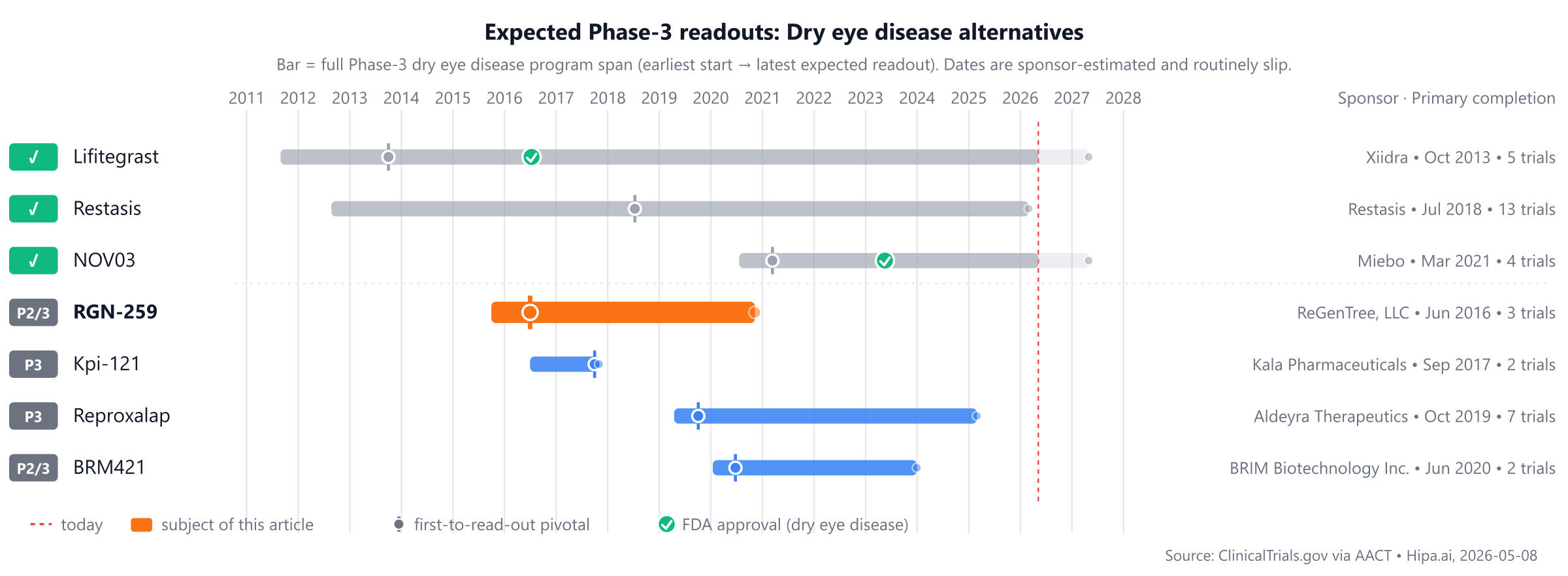
The competitive landscape includes approved comparators such as Restasis (2002), Xiidra (2016), and Miebo (2023), while RGN-259 is not yet approved. Several pipeline drugs, including Kpi-121, Reproxalap, and BRM421, remain in Phase 3, potentially 1-2 years behind the latest approvals.
Quick comparison table
| Drug | Class | Approved indications | Dosing | Year approved | Lead pivotal endpoint | Annual cost (rough) |
|---|---|---|---|---|---|---|
| RGN-259 | Thymosin beta-4 analog | — | 0.1% ophthalmic solution 5 times daily | Pipeline | — | — |
| Restasis (Restasis) | Calcineurin inhibitor immunosuppressant | dry eye disease | One drop twice a day in each eye approximately 12 hours apart | 2002 | Schirmer wetting increase of ≥ 10 mm: 15% @ 6 months | $9k |
| Lifitegrast (Xiidra) | LFA-1 antagonist | dry eye disease | 1 drop in each eye twice daily | 2016 | Eye Dryness Score (EDS) reduction vs placebo: 12.61VAS points (0-100) @ Day 84 | $9k |
| NOV03 (Miebo) | Semifluorinated alkane | dry eye disease | One drop in each affected eye four times daily | 2023 | Placebo-adjusted change from baseline in total corneal fluorescein staining (tCFS) score: -0.97points @ 8 weeks | $9k |
| Kpi-121 | — | — | — | Pipeline | — | — |
| Reproxalap | Reactive aldehyde species (RASP) modulator | — | — | Pipeline | — | — |
| BRM421 | PEDF-derived synthetic peptide | — | Topical eye drop | Pipeline | — | — |
Cost estimates are list-price approximations and do not reflect rebates, formulary tier, or out-of-pocket costs after benefits. The class-typical lead-pivotal endpoint here is Ocular discomfort score; cells render each drug's actual pivotal endpoint, which may differ. The "Year approved" column shows the FDA approval year for dry eye disease specifically — drugs approved for other indications first appear with their this-indication date, or as Pipeline if not yet approved for this indication. Cross-trial comparisons can mislead — head-to-head Phase-3 data (when present) is below.
RGN-259 vs Lifitegrast (Xiidra)
No head-to-head Phase-3 trial directly compares RGN-259 with Lifitegrast.
Cross-trial caveat: the two drugs were tested in different patient populations at different time points. Cross-trial comparisons of response rates can mislead — the only rigorous comparison is a head-to-head randomized trial.
RGN-259 vs Restasis (Restasis)
No head-to-head Phase-3 trial directly compares RGN-259 with Restasis.
Cross-trial caveat: the two drugs were tested in different patient populations at different time points. Cross-trial comparisons of response rates can mislead — the only rigorous comparison is a head-to-head randomized trial.
RGN-259 vs NOV03 (Miebo)
No head-to-head Phase-3 trial directly compares RGN-259 with NOV03.
Cross-trial caveat: the two drugs were tested in different patient populations at different time points. Cross-trial comparisons of response rates can mislead — the only rigorous comparison is a head-to-head randomized trial.
Pipeline alternatives
Several investigational IL-17 / IL-17-related drugs are currently in active Phase 3 development. These include Kpi-121 from Kala Pharmaceuticals, Inc., with its lead Phase 3 trial registered as NCT02819284. Another candidate is Reproxalap by Aldeyra Therapeutics, Inc., which has a lead Phase 3 trial identified as NCT03879863. Additionally, BRM421, developed by BRIM Biotechnology Inc., is undergoing a lead Phase 3 trial listed under NCT04343287.
Choosing between RGN-259 and its alternatives
RGN-259, a Thymosin beta-4 analog, offers a distinct mechanistic approach for dry eye management. This novel pathway may be considered for patients who have not achieved adequate relief with existing treatments that target different biological mechanisms.
Established treatments for dry eye offer varying profiles. Lifitegrast (Xiidra), an LFA-1 antagonist, demonstrated a reduction in Eye Dryness Score (EDS) of 12.61 VAS points versus placebo at Day 84 with twice-daily dosing. Restasis, a calcineurin inhibitor, showed a Schirmer wetting increase of ≥ 10 mm in 15% of patients at 6 months, also with twice-daily dosing. For patients with evaporative dry eye, NOV03 (Miebo), a semifluorinated alkane, improved total corneal fluorescein staining (tCFS) score by -0.97 points from baseline versus placebo at 8 weeks, though it requires four-times-daily administration. These agents have different mechanisms, efficacy profiles, and dosing frequencies, which may influence treatment selection based on patient-specific factors such as primary dry eye subtype, response to prior therapies, and adherence considerations. The choice of therapy involves a comprehensive assessment of individual patient needs, and clinical decisions remain at the discretion of the prescribing clinician.
Sources and methodology
Trial data was pulled from the ClinicalTrials.gov registry via the AACT relational mirror maintained by the Clinical Trials Transformation Initiative. AACT data freshness: .
Cross-trial comparison limitations:drugs without a direct head-to-head trial are compared using each drug's own pivotal trial. These trials enrolled different patient populations at different time points and used different statistical analysis sets. Cross-trial response-rate differences should not be interpreted as proof that one drug is more effective than another.
Related drug pages on Hipa.ai
Not medical advice. This page summarizes publicly-reported clinical trial data for informational purposes. Treatment decisions belong with a qualified prescribing clinician who knows your medical history. Drug approvals, dosing, and safety profiles change over time — always confirm with the current FDA prescribing information.
rgn-259rgn-259 alternativesalternativescomparisondry eye diseasethymosin-beta-4-dry-eyergn-259 vs lifitegrastrgn-259 vs restasisrgn-259 vs nov03rgn-259 vs kpi-121rgn-259 vs reproxalap