Obicetrapib is an investigational cholesteryl ester transfer protein (CETP) inhibitor. This page explores how Obicetrapib compares to other lipid-modifying agents such as Atorvastatin (Lipitor), Ezetimibe (Zetia), Inclisiran (Leqvio), Bempedoic Acid (Nexletol), and Lerodalcibep (Lerochol). Its mechanism of action uniquely targets CETP to influence both high-density lipoprotein cholesterol (HDL-C) and low-density lipoprotein cholesterol (LDL-C) levels.
Obicetrapib Alternatives: How It Compares to Other Lipid-Lowering Therapies
Hipa.ai Research · Source: ClinicalTrials.gov / AACT · Last updated: Limited data · 0/7 curated
Source: ClinicalTrials.gov via AACT · Hipa.ai, 2026-05-07Download chart as PNG
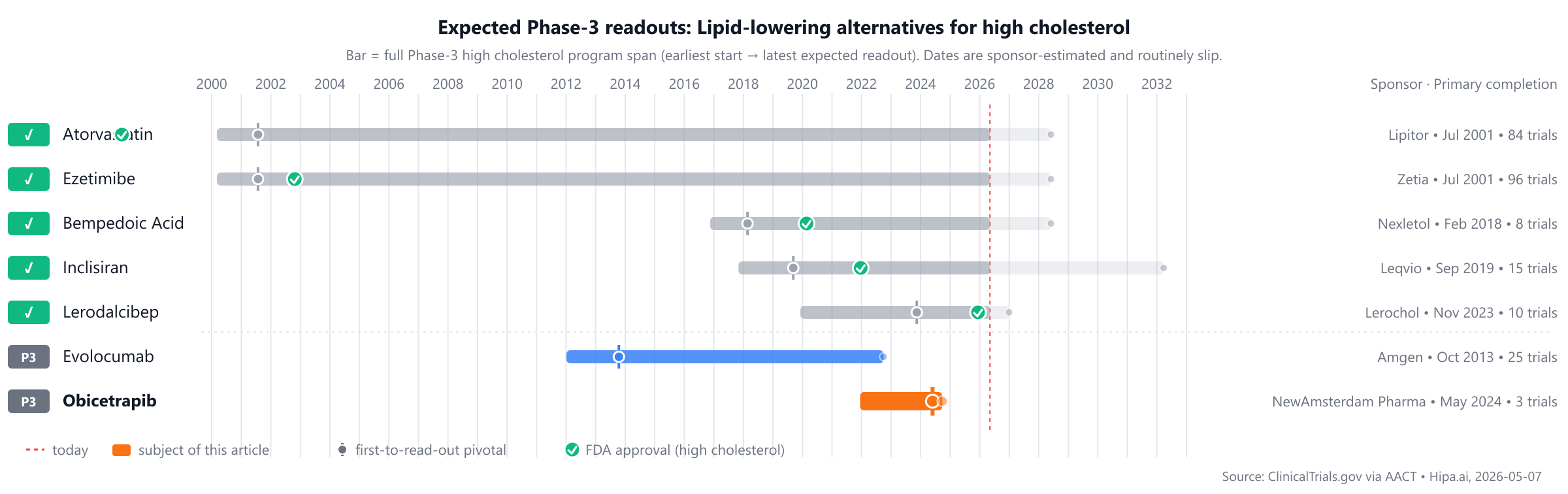
The competitive landscape includes established treatments such as Atorvastatin (Lipitor, 1996) and Ezetimibe (Zetia, 2002), alongside newer approvals like Bempedoic Acid (Nexletol, 2020) and Inclisiran (Leqvio, 2021). Obicetrapib is not yet approved, while Evolocumab is in Phase 3, potentially 1-2 years from market.
Quick comparison table
| Drug | Class | Approved indications | Dosing | Year approved | Lead pivotal endpoint | Annual cost (rough) |
|---|---|---|---|---|---|---|
| Obicetrapib | CETP inhibitor | — | 10 mg once daily | Pipeline | LDL-C reduction: 33% @ Day 84 | — |
| Atorvastatin (Lipitor) | HMG-CoA reductase inhibitor | High cholesterol, Hypertriglyceridemia, Dysbetalipoproteinemia, +2 more | 10 mg to 80 mg once daily | 1996 | LDL-C reduction: 60% @ 6 weeks | $50 |
| Ezetimibe (Zetia) | Cholesterol absorption inhibitor | High cholesterol, Homozygous familial hypercholesterolemia, Homozygous sitosterolemia | 10 mg once daily | 2002 | LDL-C reduction: 18% @ 12 weeks | — |
| Bempedoic Acid (Nexletol) | ATP citrate lyase inhibitor | high cholesterol, cardiovascular risk reduction | 180 mg orally once daily | 2020 | LDL-C reduction (placebo-corrected): 18.1% @ 12 weeks | $6k |
| Inclisiran (Leqvio) | PCSK9 inhibitor (siRNA) | high cholesterol, homozygous familial hypercholesterolemia | 284 mg subcutaneously initially, at 3 months, and then every 6 months | 2021 | LDL-C reduction: 52.3% @ 17 months | $7k |
| Lerodalcibep (Lerochol) | PCSK9 inhibitor | High cholesterol | 300 mg subcutaneously once monthly | 2025 | Placebo-adjusted LDL-C reduction: 60.27% @ 52 weeks | — |
| Evolocumab | — | — | — | Pipeline | — | — |
Cost estimates are list-price approximations and do not reflect rebates, formulary tier, or out-of-pocket costs after benefits. The class-typical lead-pivotal endpoint here is LDL-C % reduction; cells render each drug's actual pivotal endpoint, which may differ. The "Year approved" column shows the FDA approval year for high cholesterol specifically — drugs approved for other indications first appear with their this-indication date, or as Pipeline if not yet approved for this indication. Cross-trial comparisons can mislead — head-to-head Phase-3 data (when present) is below.
Obicetrapib vs Atorvastatin (Lipitor)
No head-to-head Phase-3 trial directly compares Obicetrapib with Atorvastatin.
Cross-trial caveat: the two drugs were tested in different patient populations at different time points. Cross-trial comparisons of response rates can mislead — the only rigorous comparison is a head-to-head randomized trial.
Obicetrapib vs Ezetimibe (Zetia)
The pivotal head-to-head evidence comes from a head-to-head Phase-3 trial (NCT06005597) enrolling 407 participants, primary completion 2024-09.
Effect of Fixed-Dose Combination (FDC) Compared to Placebo on LDL-C: Fixed Dose Combination -45.58 percent change from baseline; Placebo 3.03 percent change from baseline
Effect of Fixed Dose Combination (FDC) Compared to Ezetimibe Monotherapy on LDL-C: Fixed Dose Combination -45.58 percent change from baseline; Monotherapy Ezetimibe -17.63 percent change from baseline
Effect of Fixed Dose Combination (FDC) Compared to Obicetrapib Monotherapy on LDL-C: Fixed Dose Combination -45.58 percent change from baseline; Monotherapy Obicetrapib -28.82 percent change from baseline
Effect of Obicetrapib Monotherapy Compared to Placebo on LDL-C: Monotherapy Obicetrapib -28.82 percent change from baseline; Placebo 3.03 percent change from baseline
Source: ClinicalTrials.gov via AACT — pulled directly from the trial's posted results. View the full trial record.
Obicetrapib vs Inclisiran (Leqvio)
No head-to-head Phase-3 trial directly compares Obicetrapib with Inclisiran.
In separate pivotal trials, Obicetrapib reported 33% LDL-C reduction at Day 84 (NCT05142722) versus 52.3% LDL-C reduction at 17 months for Inclisiran (NCT03399370).
Cross-trial caveat: the two drugs were tested in different patient populations at different time points. Cross-trial comparisons of response rates can mislead — the only rigorous comparison is a head-to-head randomized trial.
Obicetrapib vs Bempedoic Acid (Nexletol)
No head-to-head Phase-3 trial directly compares Obicetrapib with Bempedoic Acid.
In separate pivotal trials, Obicetrapib reported 33% LDL-C reduction at Day 84 (NCT05142722) versus 18.1% LDL-C reduction (placebo-corrected) at 12 weeks for Bempedoic Acid (NCT02666664).
Cross-trial caveat: the two drugs were tested in different patient populations at different time points. Cross-trial comparisons of response rates can mislead — the only rigorous comparison is a head-to-head randomized trial.
Obicetrapib vs Lerodalcibep (Lerochol)
No head-to-head Phase-3 trial directly compares Obicetrapib with Lerodalcibep.
In separate pivotal trials, Obicetrapib reported 33% LDL-C reduction at Day 84 (NCT05142722) versus 60.27% Placebo-adjusted LDL-C reduction at 52 weeks for Lerodalcibep (NCT04806893).
Cross-trial caveat: the two drugs were tested in different patient populations at different time points. Cross-trial comparisons of response rates can mislead — the only rigorous comparison is a head-to-head randomized trial.
Pipeline alternatives
Evolocumab (Amgen) is an investigational drug in active Phase 3 development, with a lead trial identified as NCT01516879. This drug, a PCSK9 inhibitor, represents a different mechanism of action compared to Obicetrapib, which is a CETP inhibitor. Both agents aim to reduce lipid levels, but through distinct pathways.
Choosing between Obicetrapib and its alternatives
Obicetrapib, as a cholesteryl ester transfer protein (CETP) inhibitor, represents a distinct mechanism of action for lipid modification. This novel approach may be considered for patients who have not achieved their lipid-lowering goals with existing therapies or who experience intolerances to other drug classes. The specific efficacy profile and dosing regimen of Obicetrapib would guide its precise placement in a treatment algorithm.
In contrast, other lipid-lowering therapies offer diverse mechanisms and administration routes. Atorvastatin, an HMG-CoA reductase inhibitor, is a well-established oral daily therapy, demonstrating LDL-C reduction of 60% at 6 weeks with doses ranging from 10 mg to 80 mg. Ezetimibe (Zetia), a cholesterol absorption inhibitor, provides an 18% LDL-C reduction at 12 weeks with a 10 mg once-daily oral dose. For patients requiring alternative mechanisms or less frequent dosing, PCSK9 inhibitors like Inclisiran (Leqvio) and Lerodalcibep (Lerochol) are available. Inclisiran, an siRNA, reduces LDL-C by 52.3% at 17 months with a subcutaneous regimen of an initial dose, a dose at 3 months, and then every 6 months. Lerodalcibep, another PCSK9 inhibitor, achieves a placebo-adjusted LDL-C reduction of 60.27% at 52 weeks with monthly subcutaneous administration. Bempedoic Acid (Nexletol), an ATP citrate lyase inhibitor, offers an oral daily option with a placebo-corrected LDL-C reduction of 18.1% at 12 weeks at 180 mg once daily. The selection among these agents often depends on the patient's individual risk factors, tolerability to specific drug classes, desired magnitude of LDL-C reduction, and preference for administration frequency.
This information is for educational purposes only and does not constitute medical advice; all clinical decisions regarding patient care should be made by a qualified prescriber.
Sources and methodology
Trial data was pulled from the ClinicalTrials.gov registry via the AACT relational mirror maintained by the Clinical Trials Transformation Initiative. AACT data freshness: .
Head-to-head trials cited on this page:
- NCT06005597: Obicetrapib vs Ezetimibe · Study of Obicetrapib & Ezetimibe Fixed Dose Combination on Top of Maximum Tolerated Lipid-Modifying Therapies
Cross-trial comparison limitations:drugs without a direct head-to-head trial are compared using each drug's own pivotal trial. These trials enrolled different patient populations at different time points and used different statistical analysis sets. Cross-trial response-rate differences should not be interpreted as proof that one drug is more effective than another.
Related drug pages on Hipa.ai
Not medical advice. This page summarizes publicly-reported clinical trial data for informational purposes. Treatment decisions belong with a qualified prescribing clinician who knows your medical history. Drug approvals, dosing, and safety profiles change over time — always confirm with the current FDA prescribing information.
obicetrapibobicetrapib alternativesalternativescomparisonhigh cholesterolcetp-hypercholesterolemiaobicetrapib vs atorvastatinobicetrapib vs ezetimibeobicetrapib vs evolocumabobicetrapib vs inclisiranobicetrapib vs bempedoic acid