Nipocalimab is a Neonatal Fc receptor antagonist indicated for the treatment of generalized myasthenia gravis. This page compares Nipocalimab to other agents in its class, including Efgartigimod (Vyvgart) and Rozanolixizumab (Rystiggo).
Nipocalimab Alternatives: How It Compares to Other FcRn Antagonists
Hipa.ai Research · Source: ClinicalTrials.gov / AACT · Last updated: AI-augmented data · 0/5 curated
Source: ClinicalTrials.gov via AACT · Hipa.ai, 2026-05-07Download chart as PNG
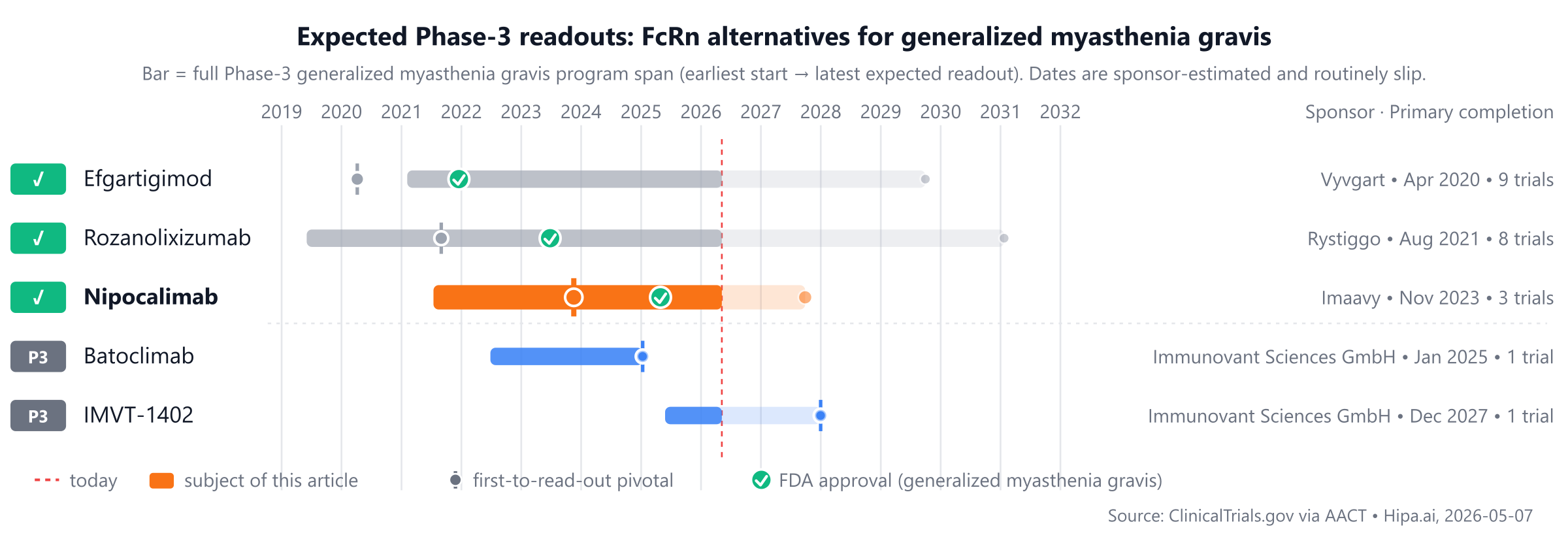
Approved comparators include Efgartigimod (Vyvgart), approved in 2021, and Rozanolixizumab (Rystiggo), approved in 2023. Nipocalimab was approved in 2025, while pipeline drugs Batoclimab and IMVT-1402 remain in Phase 3, potentially 1-2 years behind.
Quick comparison table
| Drug | Class | Approved indications | Dosing | Year approved | Lead pivotal endpoint | Annual cost (rough) |
|---|---|---|---|---|---|---|
| Nipocalimab (Imaavy) | Neonatal Fc receptor antagonist | generalized myasthenia gravis | Intravenous infusion every 2 weeks | 2025 | change from baseline in MG-ADL score: -4.7points @ 24 weeks | $324k |
| Efgartigimod (Vyvgart) | Neonatal Fc receptor blocker | generalized myasthenia gravis, chronic inflammatory demyelinating polyneuropathy | 10 mg/kg intravenously or 1,008 mg subcutaneously once weekly for 4 weeks per treatment cycle. Subsequent cycles are administered based on clinical evaluation. | 2021 | MG-ADL responders (≥2-point improvement sustained for ≥4 weeks): 67.7% @ Cycle 1 | $450k |
| Rozanolixizumab (Rystiggo) | Neonatal Fc receptor (FcRn) antagonist | generalized myasthenia gravis | Subcutaneous infusion once weekly for 6 weeks | 2023 | MG-ADL change from baseline: -3.4points @ Day 43 | $437k |
| Batoclimab | FcRn inhibitor | — | 340 mg or 680 mg subcutaneously once weekly | Pipeline | Change in MG-ADL score: 5.6points @ Week 12 | — |
| IMVT-1402 | FcRn inhibitor | — | Subcutaneous | Pipeline | — | — |
Cost estimates are list-price approximations and do not reflect rebates, formulary tier, or out-of-pocket costs after benefits. The class-typical lead-pivotal endpoint here is MG-ADL score change; cells render each drug's actual pivotal endpoint, which may differ. The "Year approved" column shows the FDA approval year for generalized myasthenia gravis specifically — drugs approved for other indications first appear with their this-indication date, or as Pipeline if not yet approved for this indication. Cross-trial comparisons can mislead — head-to-head Phase-3 data (when present) is below.
Nipocalimab vs Efgartigimod (Vyvgart)
The pivotal head-to-head evidence comes from a head-to-head Phase-3 trial (NCT07217587) enrolling 115 participants, primary completion 2027-09.
Primary-endpoint values for NCT07217587 are not yet posted in the AACT results database.
Source: ClinicalTrials.gov via AACT — pulled directly from the trial's posted results. View the full trial record.
Nipocalimab vs Rozanolixizumab (Rystiggo)
No head-to-head Phase-3 trial directly compares Nipocalimab with Rozanolixizumab.
In separate pivotal trials, Nipocalimab reported -4.7points change from baseline in MG-ADL score at 24 weeks (NCT04951622) versus -3.4points MG-ADL change from baseline at Day 43 for Rozanolixizumab (NCT03971422).
Cross-trial caveat: the two drugs were tested in different patient populations at different time points. Cross-trial comparisons of response rates can mislead — the only rigorous comparison is a head-to-head randomized trial.
Pipeline alternatives
In addition to nipocalimab, other investigational FcRn inhibitors are in active Phase 3 development. Batoclimab, sponsored by Immunovant Sciences GmbH, is an FcRn inhibitor with its lead Phase 3 trial NCT05403541. This agent is approximately 1-2 years behind nipocalimab in its development timeline. Another FcRn inhibitor from Immunovant Sciences GmbH, IMVT-1402, is also in Phase 3 development, with its lead trial identified as NCT07039916.
Choosing between Nipocalimab and its alternatives
Nipocalimab is an FcRn antagonist, a mechanism shared with other agents in this class. When selecting an FcRn antagonist, clinicians consider factors such as the specific disease indication, the desired clinical response, and the practicalities of administration. The choice often weighs the efficacy profile, dosing frequency, and route of administration against individual patient characteristics and preferences.
Among the established FcRn antagonists, efgartigimod (Vyvgart) has demonstrated efficacy with 67.7% of patients achieving an MG-ADL responder status (≥2-point improvement sustained for ≥4 weeks) in Cycle 1. Efgartigimod can be administered at 10 mg/kg intravenously or 1,008 mg subcutaneously once weekly for 4 weeks per treatment cycle, with subsequent cycles based on clinical evaluation. Rozanolixizumab (Rystiggo), another FcRn antagonist, showed a mean MG-ADL change from baseline of -3.4 points by Day 43. Its dosing involves subcutaneous infusion once weekly for 6 weeks. The availability of both intravenous and subcutaneous options, as well as different dosing schedules, provides flexibility for prescribers and patients.
This information is for comparative purposes only and does not constitute medical advice; clinical decisions must always be made by a qualified healthcare professional in consultation with the patient.
Sources and methodology
Trial data was pulled from the ClinicalTrials.gov registry via the AACT relational mirror maintained by the Clinical Trials Transformation Initiative. AACT data freshness: .
Head-to-head trials cited on this page:
- NCT07217587: Nipocalimab vs Efgartigimod · Comparative Efficacy of Nipocalimab and Efgartigimod in Participants With Generalized Myasthenia Gravis
Cross-trial comparison limitations:drugs without a direct head-to-head trial are compared using each drug's own pivotal trial. These trials enrolled different patient populations at different time points and used different statistical analysis sets. Cross-trial response-rate differences should not be interpreted as proof that one drug is more effective than another.
Related drug pages on Hipa.ai
Not medical advice. This page summarizes publicly-reported clinical trial data for informational purposes. Treatment decisions belong with a qualified prescribing clinician who knows your medical history. Drug approvals, dosing, and safety profiles change over time — always confirm with the current FDA prescribing information.
nipocalimabnipocalimab alternativesalternativescomparisongeneralized myasthenia gravisnipocalimab-fcrn-myasthenia-gravisnipocalimab vs efgartigimodnipocalimab vs rozanolixizumabnipocalimab vs batoclimabnipocalimab vs imvt-1402