Fenebrutinib is a Bruton's tyrosine kinase (BTK) inhibitor. This page compares Fenebrutinib with other treatments including Ocrelizumab (Ocrevus), Teriflunomide (Aubagio), Ofatumumab (Kesimpta), Ublituximab (Briumvi), and Remibrutinib (Rhapsido). These agents vary in their mechanisms of action and administration frequencies.
Fenebrutinib Alternatives: How It Compares to Other Multiple Sclerosis Treatments
Hipa.ai Research · Source: ClinicalTrials.gov / AACT · Last updated: AI-augmented data · 0/8 curated
Source: ClinicalTrials.gov via AACT · Hipa.ai, 2026-05-07Download chart as PNG
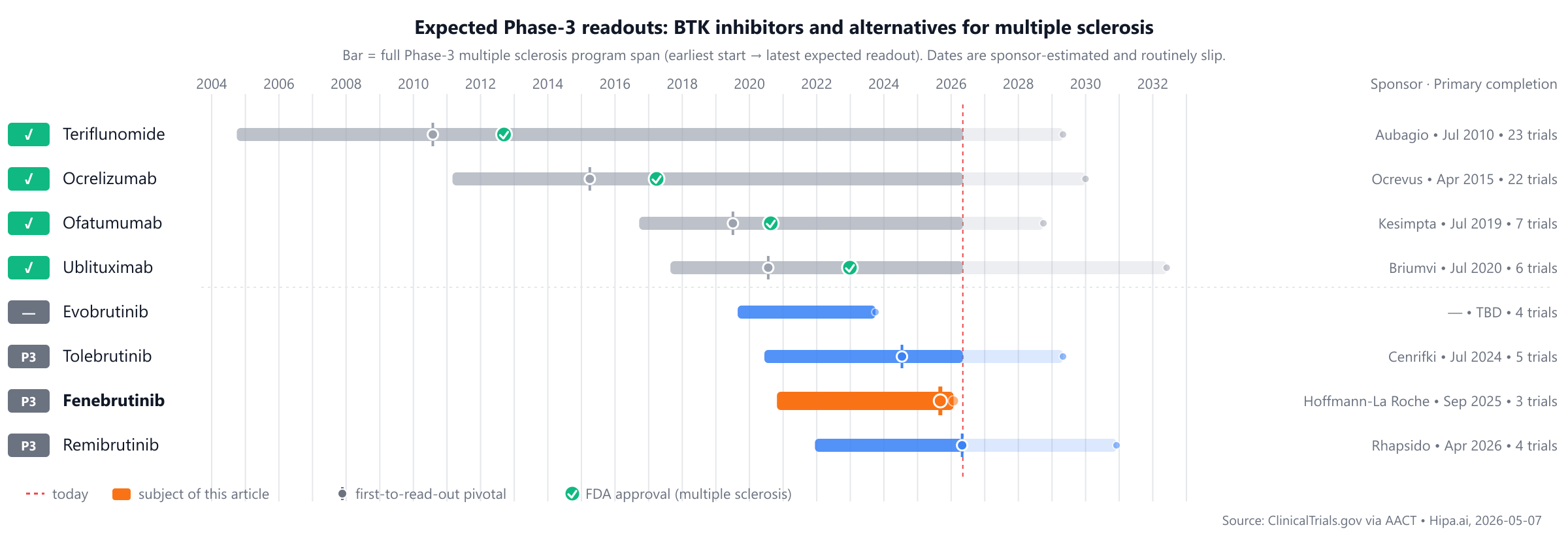
Approved comparators like Ofatumumab (Kesimpta, 2009) and Teriflunomide (Aubagio, 2012) are well-established, with Fenebrutinib not yet approved, while Tolebrutinib, Remibrutinib, and Evobrutinib remain in Phase 3, indicating they are approximately 1-2 years behind.
Quick comparison table
| Drug | Class | Approved indications | Dosing | Year approved | Lead pivotal endpoint | Annual cost (rough) |
|---|---|---|---|---|---|---|
| Fenebrutinib | BTK inhibitor | — | Oral, twice daily | Pipeline | 51.1% vs teriflunomide @ 96 weeks | — |
| Teriflunomide (Aubagio) | Pyrimidine synthesis inhibitor | Multiple sclerosis | 7 mg or 14 mg orally once daily | 2012 | 31.5% @ 108 weeks | $110k |
| Ocrelizumab (Ocrevus) | Anti-CD20 monoclonal antibody | Multiple Sclerosis | Initial dose of 300 mg IV infusion, followed 2 weeks later by a second 300 mg IV infusion. Maintenance dose of 600 mg IV infusion every 6 months. | 2017 | 0.16relapses/year @ 96 weeks | $70k |
| Ofatumumab (Kesimpta) | Anti-CD20 monoclonal antibody | Chronic Lymphocytic Leukemia, Multiple Sclerosis | 20 mg subcutaneously once monthly (following initial loading doses at weeks 0, 1, and 2) | 2020 | 0.11relapses/year @ up to 30 months | $118k |
| Ublituximab (Briumvi) | Anti-CD20 monoclonal antibody | Relapsing forms of multiple sclerosis | 150 mg IV infusion on Day 1, 450 mg on Day 15, then 450 mg every 24 weeks | 2022 | 0.076relapses/year @ 96 weeks | $59k |
| Tolebrutinib (Cenrifki) | BTK inhibitor | — | 60 mg orally once daily | Pipeline | 6-month confirmed disability progression (CDP) risk reduction: 31% @ 24 months | — |
| Remibrutinib (Rhapsido) | BTK inhibitor | chronic spontaneous urticaria | Oral twice daily | Pipeline | — | — |
| Evobrutinib | BTK inhibitor | — | — | Pipeline | — | — |
Cost estimates are list-price approximations and do not reflect rebates, formulary tier, or out-of-pocket costs after benefits. The class-typical lead-pivotal endpoint here is Annualized Relapse Rate (ARR); cells render each drug's actual pivotal endpoint, which may differ. The "Year approved" column shows the FDA approval year for multiple sclerosis specifically — drugs approved for other indications first appear with their this-indication date, or as Pipeline if not yet approved for this indication. Cross-trial comparisons can mislead — head-to-head Phase-3 data (when present) is below.
Fenebrutinib vs Ocrelizumab (Ocrevus)
The pivotal head-to-head evidence comes from a head-to-head Phase-3 trial (NCT04544449) enrolling 985 participants, primary completion 2025-09.
Primary-endpoint values for NCT04544449 are not yet posted in the AACT results database.
Source: ClinicalTrials.gov via AACT — pulled directly from the trial's posted results. View the full trial record.
Fenebrutinib vs Teriflunomide (Aubagio)
The pivotal head-to-head evidence comes from a head-to-head Phase-3 trial (NCT04586023) enrolling 751 participants, primary completion 2025-09.
Primary-endpoint values for NCT04586023 are not yet posted in the AACT results database.
Source: ClinicalTrials.gov via AACT — pulled directly from the trial's posted results. View the full trial record.
Fenebrutinib vs Ofatumumab (Kesimpta)
No head-to-head Phase-3 trial directly compares Fenebrutinib with Ofatumumab.
In separate pivotal trials, Fenebrutinib reported 51.1% vs teriflunomide Annualized relapse rate (ARR) reduction at 96 weeks (NCT04586010) versus 0.11relapses/year Annualized Relapse Rate (ARR) at up to 30 months for Ofatumumab (NCT02792218).
Cross-trial caveat: the two drugs were tested in different patient populations at different time points. Cross-trial comparisons of response rates can mislead — the only rigorous comparison is a head-to-head randomized trial.
Fenebrutinib vs Ublituximab (Briumvi)
No head-to-head Phase-3 trial directly compares Fenebrutinib with Ublituximab.
In separate pivotal trials, Fenebrutinib reported 51.1% vs teriflunomide Annualized relapse rate (ARR) reduction at 96 weeks (NCT04586010) versus 0.076relapses/year Annualized Relapse Rate (ARR) at 96 weeks for Ublituximab (NCT03277261).
Cross-trial caveat: the two drugs were tested in different patient populations at different time points. Cross-trial comparisons of response rates can mislead — the only rigorous comparison is a head-to-head randomized trial.
Fenebrutinib vs Remibrutinib (Rhapsido)
No head-to-head Phase-3 trial directly compares Fenebrutinib with Remibrutinib.
Cross-trial caveat: the two drugs were tested in different patient populations at different time points. Cross-trial comparisons of response rates can mislead — the only rigorous comparison is a head-to-head randomized trial.
Pipeline alternatives
Several investigational drugs are currently in active Phase 3 development. These include Tolebrutinib, sponsored by Sanofi, with its lead Phase 3 trial identified as NCT04410978. Another agent, Remibrutinib from Novartis, is also undergoing Phase 3 studies, with a key trial listed as NCT05156281. Additionally, Evobrutinib is in Phase 3 development, though its sponsor was not specified.
Choosing between Fenebrutinib and its alternatives
Fenebrutinib, a Bruton's tyrosine kinase (BTK) inhibitor, offers a distinct mechanism of action compared to the anti-CD20 monoclonal antibodies, such as Ocrelizumab, Ofatumumab, and Ublituximab, or the pyrimidine synthesis inhibitor Teriflunomide. This difference in mechanism may be a consideration for clinicians when exploring therapeutic options for multiple sclerosis, particularly when a different pathway of action is desired.
Conversely, other established treatments offer varied profiles that may be preferred depending on individual patient needs. Anti-CD20 monoclonal antibodies, including Ocrelizumab, Ofatumumab, and Ublituximab, have demonstrated efficacy in reducing annualized relapse rates. Ublituximab reported an ARR of 0.076 relapses/year at 96 weeks, Ofatumumab an ARR of 0.11 relapses/year over up to 30 months, and Ocrelizumab an ARR of 0.16 relapses/year at 96 weeks. These agents offer different administration routes: Ocrelizumab is given via intravenous infusion every 6 months (after initial doses), Ublituximab via intravenous infusion every 24 weeks (after initial doses), and Ofatumumab via subcutaneous injection once monthly (after initial loading doses). For patients preferring an oral regimen, Teriflunomide, a pyrimidine synthesis inhibitor, is administered orally once daily and demonstrated a 31.5% reduction in annualized relapse rate at 108 weeks. Remibrutinib, another BTK inhibitor, is also an oral option, administered twice daily. Clinical decisions often weigh factors such as established efficacy data, administration route, and individual patient characteristics.
This information is not intended as medical advice; clinical decisions should always be made by a qualified healthcare professional in consultation with the patient.
Sources and methodology
Trial data was pulled from the ClinicalTrials.gov registry via the AACT relational mirror maintained by the Clinical Trials Transformation Initiative. AACT data freshness: .
Head-to-head trials cited on this page:
- NCT04544449: Fenebrutinib vs Ocrelizumab · A Study to Evaluate the Efficacy and Safety of Fenebrutinib Compared With Ocrelizumab in Adult Participants With Primary…
- NCT04586023: Fenebrutinib vs Teriflunomide · Study to Evaluate the Efficacy and Safety of Fenebrutinib Compared With Teriflunomide in Relapsing Multiple Sclerosis (R…
Cross-trial comparison limitations:drugs without a direct head-to-head trial are compared using each drug's own pivotal trial. These trials enrolled different patient populations at different time points and used different statistical analysis sets. Cross-trial response-rate differences should not be interpreted as proof that one drug is more effective than another.
Related drug pages on Hipa.ai
Not medical advice. This page summarizes publicly-reported clinical trial data for informational purposes. Treatment decisions belong with a qualified prescribing clinician who knows your medical history. Drug approvals, dosing, and safety profiles change over time — always confirm with the current FDA prescribing information.
fenebrutinibfenebrutinib alternativesalternativescomparisonmultiple sclerosisfenebrutinib-btk-multiple-sclerosisfenebrutinib vs ocrelizumabfenebrutinib vs teriflunomidefenebrutinib vs ofatumumabfenebrutinib vs ublituximabfenebrutinib vs tolebrutinib