Donanemab is an amyloid beta-directed antibody approved for the treatment of Alzheimer's disease. This page compares Donanemab to other therapies, including Aducanumab (Aduhelm), Donepezil (Aricept), Galantamine (Razadyne), and Rivastigmine (Exelon). These agents represent different therapeutic approaches to managing Alzheimer's disease.
Donanemab Alternatives: How It Compares to Other Alzheimer's Disease Treatments
Hipa.ai Research · Source: ClinicalTrials.gov / AACT · Last updated: AI-augmented data · 0/7 curated
Source: ClinicalTrials.gov via AACT · Hipa.ai, 2026-05-07Download chart as PNG
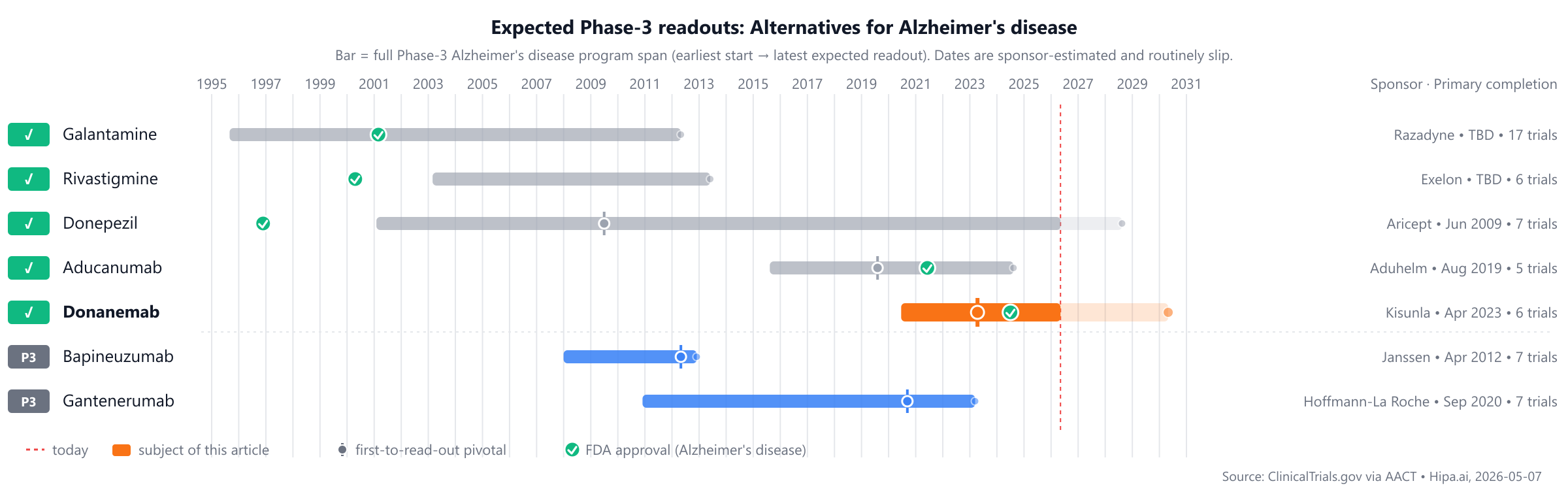
Donepezil (Aricept) and Rivastigmine (Exelon) were approved in 1996 and 2000, respectively, long before Donanemab's 2024 approval. Gantenerumab and Bapineuzumab remain in Phase 3, potentially 1-2 years behind Donanemab.
Quick comparison table
| Drug | Class | Approved indications | Dosing | Year approved | Lead pivotal endpoint | Annual cost (rough) |
|---|---|---|---|---|---|---|
| Donanemab (Kisunla) | Amyloid beta-directed antibody | Alzheimer's disease | Intravenous infusion every 4 weeks (350 mg for infusion 1, 700 mg for infusion 2, 1050 mg for infusion 3, and 1400 mg for infusion 4 and beyond) | 2024 | iADRS change from baseline: -6.02points @ 76 weeks | $32k |
| Donepezil (Aricept) | Acetylcholinesterase inhibitor | Alzheimer's disease | 5 mg to 10 mg orally once daily for mild-to-moderate disease; 23 mg orally once daily for moderate-to-severe disease | 1996 | Severe Impairment Battery (SIB) score difference: 2.2points @ 24 weeks | $250 |
| Rivastigmine (Exelon) | Acetylcholinesterase inhibitor | Alzheimer's disease, Parkinson's disease dementia | 4.6 to 13.3 mg/24 hours (transdermal patch); 6 to 12 mg/day (oral) | 2000 | — | $635 |
| Galantamine (Razadyne) | Acetylcholinesterase inhibitor | Alzheimer's disease | 16 to 24 mg daily | 2001 | ADAS-Cog 11 score (placebo-adjusted change): -3.9points @ 6 months | $360 |
| Aducanumab (Aduhelm) | Amyloid beta-directed antibody | Alzheimer's disease | 10 mg/kg IV infusion every 4 weeks (after initial titration) | 2021 | -0.39points @ 78 weeks | $28k |
| Gantenerumab | Anti-amyloid beta monoclonal antibody | — | — | Pipeline | -0.31points @ 116 weeks | — |
| Bapineuzumab | Anti-amyloid monoclonal antibody | — | — | Pipeline | — | — |
Cost estimates are list-price approximations and do not reflect rebates, formulary tier, or out-of-pocket costs after benefits. The class-typical lead-pivotal endpoint here is CDR-SB change; cells render each drug's actual pivotal endpoint, which may differ. The "Year approved" column shows the FDA approval year for Alzheimer's disease specifically — drugs approved for other indications first appear with their this-indication date, or as Pipeline if not yet approved for this indication. Cross-trial comparisons can mislead — head-to-head Phase-3 data (when present) is below.
Donanemab vs Aducanumab (Aduhelm)
The pivotal head-to-head evidence comes from a head-to-head Phase-3 trial (NCT05108922) enrolling 148 participants, primary completion 2022-09.
Percentage of Participants Who Reach Complete Amyloid Plaque Clearance on Florbetapir F18 PET Scan in the Low/Medium (Intermediate) Subpopulation (Superiority) on Donanemab Versus Aducanumab: Aducanumab 3.8 Percentage of participants; Aducanumab 43.48 percentage of participants; Aducanumab 18.52 percentage of participants; Donanemab 72.00 percentage of participants; Donanemab 38.5 Percentage of participants; Donanemab 76.00 percentage of participants
Percentage of Participants Who Reach Complete Amyloid Plaque Clearance on Florbetapir F18 Positron Emission Tomography (PET) Scan (Superiority) on Donanemab Versus Aducanumab: Aducanumab 24.59 Percentage of participants; Aducanumab 1.6 Percentage of participants
Source: ClinicalTrials.gov via AACT — pulled directly from the trial's posted results. View the full trial record.
Donanemab vs Donepezil (Aricept)
No head-to-head Phase-3 trial directly compares Donanemab with Donepezil.
In separate pivotal trials, Donanemab reported -6.02points iADRS change from baseline at 76 weeks (NCT04437511) versus 2.2points Severe Impairment Battery (SIB) score difference at 24 weeks for Donepezil (NCT00478205).
Cross-trial caveat: the two drugs were tested in different patient populations at different time points. Cross-trial comparisons of response rates can mislead — the only rigorous comparison is a head-to-head randomized trial.
Donanemab vs Galantamine (Razadyne)
No head-to-head Phase-3 trial directly compares Donanemab with Galantamine.
In separate pivotal trials, Donanemab reported -6.02points iADRS change from baseline at 76 weeks (NCT04437511) versus -3.9points ADAS-Cog 11 score (placebo-adjusted change) at 6 months for Galantamine (NCT00253201).
Cross-trial caveat: the two drugs were tested in different patient populations at different time points. Cross-trial comparisons of response rates can mislead — the only rigorous comparison is a head-to-head randomized trial.
Donanemab vs Rivastigmine (Exelon)
No head-to-head Phase-3 trial directly compares Donanemab with Rivastigmine.
Cross-trial caveat: the two drugs were tested in different patient populations at different time points. Cross-trial comparisons of response rates can mislead — the only rigorous comparison is a head-to-head randomized trial.
Pipeline alternatives
Investigational agents in active Phase 3 development include Gantenerumab from Hoffmann-La Roche, with its lead Phase 3 trial identified as NCT01224106. Another agent, Bapineuzumab, is being developed by JANSSEN Alzheimer Immunotherapy Research & Development, LLC, with its lead Phase 3 trial at NCT00575055.
Choosing between Donanemab and its alternatives
Donanemab, an amyloid beta-directed antibody, offers a distinct mechanism of action for Alzheimer's disease by targeting amyloid plaques in the brain. This approach differs from acetylcholinesterase inhibitors such as Donepezil, Galantamine, and Rivastigmine, which primarily aim to manage symptomatic cognitive decline. For patients where amyloid plaque reduction is a primary therapeutic goal, Donanemab may be considered, similar to other amyloid-targeting agents like Aducanumab.
Conversely, established treatments offer different considerations. Donepezil (Aricept), an oral acetylcholinesterase inhibitor, showed a 2.2 point difference in Severe Impairment Battery (SIB) score at 24 weeks in studies, with dosing typically ranging from 5 mg to 10 mg orally once daily for mild-to-moderate disease, and 23 mg orally once daily for moderate-to-severe disease. Galantamine (Razadyne), also an oral acetylcholinesterase inhibitor, demonstrated a -3.9 point placebo-adjusted change in ADAS-Cog 11 score at 6 months, typically dosed at 16 to 24 mg daily. Rivastigmine (Exelon) is available in both oral and transdermal patch formulations, with patches delivering 4.6 to 13.3 mg/24 hours and oral doses ranging from 6 to 12 mg/day. Aducanumab (Aduhelm), another amyloid beta-directed antibody, showed a -0.39 point change from baseline in CDR-SB at 78 weeks, administered as a 10 mg/kg IV infusion every 4 weeks after initial titration. These agents may offer advantages in terms of longer clinical experience, potentially lower cost, and different safety profiles, which can be important factors for specific patient populations or those with contraindications to newer therapies.
This information is for educational purposes only and does not constitute medical advice; all clinical decisions should be made by a qualified prescriber in consultation with the patient.
Sources and methodology
Trial data was pulled from the ClinicalTrials.gov registry via the AACT relational mirror maintained by the Clinical Trials Transformation Initiative. AACT data freshness: .
Head-to-head trials cited on this page:
- NCT05108922: Donanemab vs Aducanumab · A Study of Donanemab (LY3002813) Compared With Aducanumab in Participants With Early Symptomatic Alzheimer's Disease (TR…
Cross-trial comparison limitations:drugs without a direct head-to-head trial are compared using each drug's own pivotal trial. These trials enrolled different patient populations at different time points and used different statistical analysis sets. Cross-trial response-rate differences should not be interpreted as proof that one drug is more effective than another.
Related drug pages on Hipa.ai
Not medical advice. This page summarizes publicly-reported clinical trial data for informational purposes. Treatment decisions belong with a qualified prescribing clinician who knows your medical history. Drug approvals, dosing, and safety profiles change over time — always confirm with the current FDA prescribing information.
donanemabdonanemab alternativesalternativescomparisonAlzheimer's diseaseanti-amyloid-mab-alzheimersdonanemab vs aducanumabdonanemab vs donepezildonanemab vs galantaminedonanemab vs rivastigminedonanemab vs gantenerumab