Crovalimab is a Complement C5 inhibitor approved for the treatment of Paroxysmal Nocturnal Hemoglobinuria. This page compares Crovalimab with other complement inhibitors including Eculizumab (Soliris), Ravulizumab (Ultomiris), Pegcetacoplan (Empaveli, Syfovre), Iptacopan (Fabhalta), Danicopan (Voydeya), and Pozelimab (Veopoz). A notable difference for Crovalimab is its subcutaneous administration, which may offer a distinct dosing experience.
Crovalimab Alternatives: How It Compares to Other Complement Inhibitors
Hipa.ai Research · Source: ClinicalTrials.gov / AACT · Last updated: AI-augmented data · 1/8 curated
Source: ClinicalTrials.gov via AACT · Hipa.ai, 2026-05-07Download chart as PNG
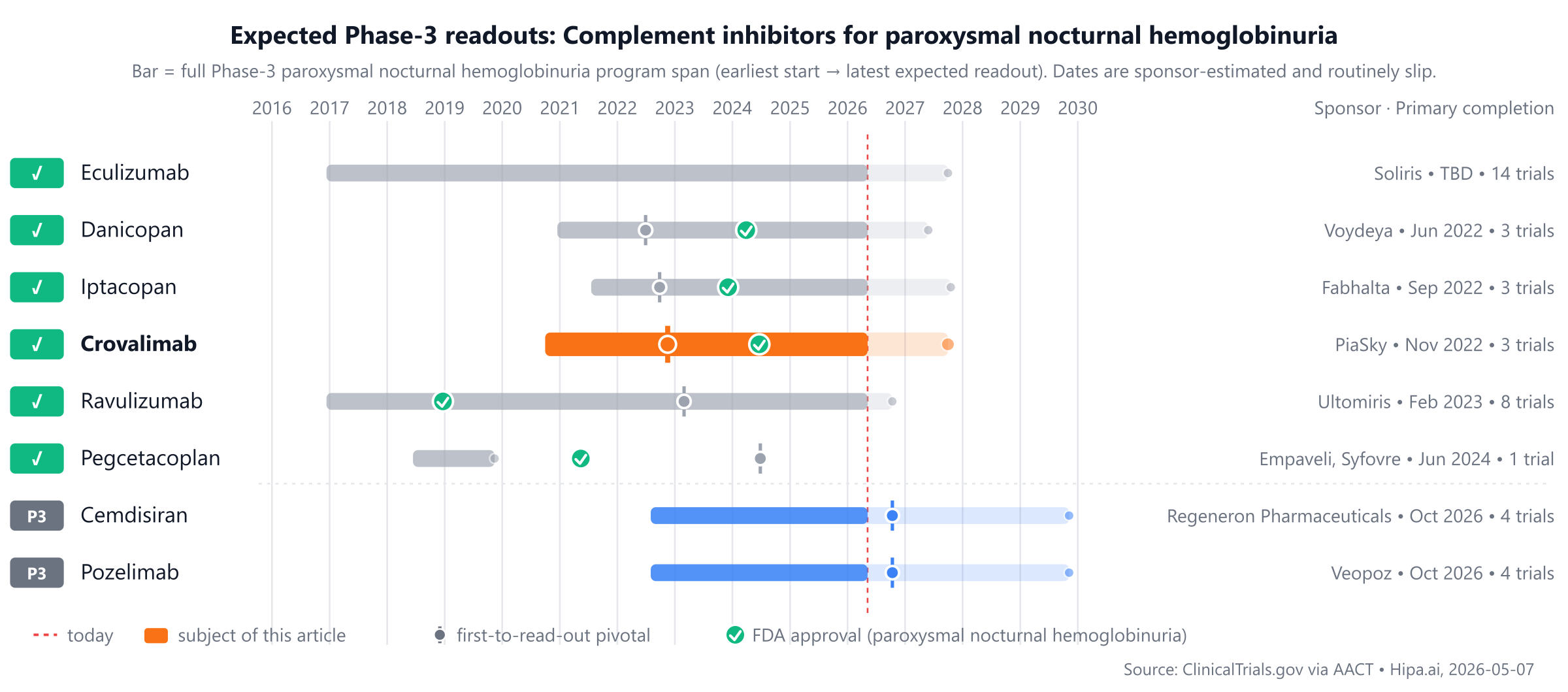
The competitive landscape includes established therapies like Eculizumab (Soliris) approved in 2007 and Ravulizumab (Ultomiris) in 2018. Crovalimab, approved in 2024, joins this market while pipeline candidates such as Cemdisiran and Pozelimab are approximately 1-2 years behind.
Quick comparison table
| Drug | Class | Approved indications | Dosing | Year approved | Lead pivotal endpoint | Annual cost (rough) |
|---|---|---|---|---|---|---|
| Crovalimab (PiaSky) | Complement C5 inhibitor | Paroxysmal Nocturnal Hemoglobinuria | Weight-based tiered dosing. ≥40 kg to <100 kg: 1,000 mg IV on Day 1, then 340 mg SC weekly on Days 2, 8, 15, and 22; followed by 680 mg SC every 4 weeks starting Day 29. ≥100 kg: 1,500 mg IV on Day 1, then 340 mg SC weekly on Days 2, 8, 15, and 22; followed by 1,020 mg SC every 4 weeks starting Day 29. | 2024 | hemolysis control (LDH ≤1.5 × ULN): 79.3% @ week 5 to week 25 | — |
| Eculizumab (Soliris) | Complement C5 inhibitor | paroxysmal nocturnal hemoglobinuria, atypical hemolytic uremic syndrome, generalized myasthenia gravis, +1 more | 600 mg IV weekly x4, then 900 mg week 5, then 900 mg every 2 weeks | 2007 | 51% @ 26 weeks | $500k |
| Ravulizumab (Ultomiris) | Complement C5 inhibitor | Paroxysmal nocturnal hemoglobinuria, Atypical hemolytic uremic syndrome, Generalized myasthenia gravis, +1 more | Weight-based intravenous loading dose on Day 1, followed by maintenance doses starting on Day 15 and every 8 weeks thereafter | 2018 | 73.6% @ 26 weeks | $520k |
| Pegcetacoplan (Empaveli, Syfovre) | Complement C3 inhibitor | Paroxysmal nocturnal hemoglobinuria (PNH), Geographic atrophy secondary to age-related macular degeneration, C3 glomerulopathy (C3G), +1 more | 1,080 mg twice weekly via subcutaneous infusion (Empaveli); intravitreal injection (Syfovre) | 2021 | Urine protein-to-creatinine ratio (UPCR) reduction: 68.3% @ 26 weeks | $517k |
| Iptacopan (Fabhalta) | Complement factor B inhibitor | paroxysmal nocturnal hemoglobinuria, immunoglobulin A nephropathy, complement 3 glomerulopathy | 200 mg orally twice daily | 2023 | Hemoglobin increase ≥ 2 g/dL without RBC transfusions: 82.3% @ 24 weeks | $550k |
| Danicopan (Voydeya) | Complement factor D inhibitor | Paroxysmal nocturnal hemoglobinuria | 150 mg orally three times daily | 2024 | Change in hemoglobin vs placebo: 2.44g/dL @ 12 weeks | $88k |
| Cemdisiran | C5 inhibitor | — | Subcutaneous injection | Pipeline | — | — |
| Pozelimab (Veopoz) | Complement C5 inhibitor | CHAPLE disease | 30 mg/kg intravenous loading dose on Day 1, followed by 10 mg/kg subcutaneous injection once weekly starting on Day 8 | Pipeline | — | $1800k |
Cost estimates are list-price approximations and do not reflect rebates, formulary tier, or out-of-pocket costs after benefits. The class-typical lead-pivotal endpoint here is Transfusion avoidance; cells render each drug's actual pivotal endpoint, which may differ. The "Year approved" column shows the FDA approval year for paroxysmal nocturnal hemoglobinuria specifically — drugs approved for other indications first appear with their this-indication date, or as Pipeline if not yet approved for this indication. Cross-trial comparisons can mislead — head-to-head Phase-3 data (when present) is below.
Crovalimab vs Eculizumab (Soliris)
The pivotal head-to-head evidence comes from a head-to-head Phase-3 trial (NCT04434092) enrolling 210 participants, primary completion 2022-11.
Percentage of Participants With Hemolysis Control Measured by LDH: Arm A: Crovalimab 79.3 percentage of participants; Arm B: Eculizumab 79.0 percentage of participants
Percentage of Participants With Transfusion Avoidance (TA): Arm A: Crovalimab 65.7 percentage of participants; Arm B: Eculizumab 68.1 percentage of participants
Source: ClinicalTrials.gov via AACT — pulled directly from the trial's posted results. View the full trial record.
Crovalimab vs Ravulizumab (Ultomiris)
No head-to-head Phase-3 trial directly compares Crovalimab with Ravulizumab.
In separate pivotal trials, Crovalimab reported 79.3% hemolysis control (LDH ≤1.5 × ULN) at week 5 to week 25 (NCT04434092) versus 73.6% Transfusion avoidance at 26 weeks for Ravulizumab (NCT02946463).
Cross-trial caveat: the two drugs were tested in different patient populations at different time points. Cross-trial comparisons of response rates can mislead — the only rigorous comparison is a head-to-head randomized trial.
Crovalimab vs Pegcetacoplan (Empaveli, Syfovre)
No head-to-head Phase-3 trial directly compares Crovalimab with Pegcetacoplan.
In separate pivotal trials, Crovalimab reported 79.3% hemolysis control (LDH ≤1.5 × ULN) at week 5 to week 25 (NCT04434092) versus 68.3% Urine protein-to-creatinine ratio (UPCR) reduction at 26 weeks for Pegcetacoplan (NCT05067127).
Cross-trial caveat: the two drugs were tested in different patient populations at different time points. Cross-trial comparisons of response rates can mislead — the only rigorous comparison is a head-to-head randomized trial.
Crovalimab vs Iptacopan (Fabhalta)
No head-to-head Phase-3 trial directly compares Crovalimab with Iptacopan.
In separate pivotal trials, Crovalimab reported 79.3% hemolysis control (LDH ≤1.5 × ULN) at week 5 to week 25 (NCT04434092) versus 82.3% Hemoglobin increase ≥ 2 g/dL without RBC transfusions at 24 weeks for Iptacopan (NCT04558918).
Cross-trial caveat: the two drugs were tested in different patient populations at different time points. Cross-trial comparisons of response rates can mislead — the only rigorous comparison is a head-to-head randomized trial.
Crovalimab vs Danicopan (Voydeya)
No head-to-head Phase-3 trial directly compares Crovalimab with Danicopan.
In separate pivotal trials, Crovalimab reported 79.3% hemolysis control (LDH ≤1.5 × ULN) at week 5 to week 25 (NCT04434092) versus 2.44g/dL Change in hemoglobin vs placebo at 12 weeks for Danicopan (NCT04469465).
Cross-trial caveat: the two drugs were tested in different patient populations at different time points. Cross-trial comparisons of response rates can mislead — the only rigorous comparison is a head-to-head randomized trial.
Crovalimab vs Pozelimab (Veopoz)
No head-to-head Phase-3 trial directly compares Crovalimab with Pozelimab.
Cross-trial caveat: the two drugs were tested in different patient populations at different time points. Cross-trial comparisons of response rates can mislead — the only rigorous comparison is a head-to-head randomized trial.
Pipeline alternatives
Investigational C5 inhibitors Cemdisiran and Pozelimab, both from Regeneron Pharmaceuticals, are currently in active Phase 3 development. A lead Phase 3 trial for both agents is registered under NCT05133531. These agents are approximately 1-2 years behind other C5 inhibitors like Crovalimab in their development timeline.
Choosing between Crovalimab and its alternatives
When selecting a complement inhibitor, clinicians often weigh factors such as mechanism of action, efficacy, and dosing convenience. Crovalimab is a Complement C5 inhibitor, a mechanism shared with eculizumab, ravulizumab, and pozelimab. For patients requiring C5 inhibition, differences in administration frequency and route can be important. For instance, ravulizumab offers an extended dosing interval of every 8 weeks after an initial loading phase, compared to eculizumab's every 2-week maintenance schedule. While specific efficacy data for Crovalimab is not provided, other C5 inhibitors like ravulizumab demonstrated 73.6% transfusion avoidance at 26 weeks, compared to 51% for eculizumab at the same time point. The choice among C5 inhibitors may therefore depend on the specific patient profile, desired dosing regimen, and comparative efficacy data as it becomes available.
Alternatively, other complement inhibitors target different components of the complement cascade, which may be preferred for specific patient subgroups or disease presentations. Pegcetacoplan, a Complement C3 inhibitor, demonstrated a 68.3% reduction in urine protein-to-creatinine ratio (UPCR) at 26 weeks with twice-weekly subcutaneous dosing. For patients seeking an oral option, iptacopan, a Complement factor B inhibitor, showed an 82.3% rate of hemoglobin increase ≥ 2 g/dL without red blood cell transfusions at 24 weeks, administered orally twice daily. Danicopan, targeting Complement factor D, also offers an oral option, with a mean change in hemoglobin of 2.44 g/dL versus placebo at 12 weeks with three times daily dosing. These agents offer distinct mechanisms and routes of administration, potentially suiting different clinical needs based on their specific efficacy profiles and patient preferences for oral versus injectable therapies.
This information is for educational purposes only and does not constitute medical advice; all clinical decisions should be made by a qualified prescriber.
Sources and methodology
Trial data was pulled from the ClinicalTrials.gov registry via the AACT relational mirror maintained by the Clinical Trials Transformation Initiative. AACT data freshness: .
Head-to-head trials cited on this page:
- NCT04434092: Crovalimab vs Eculizumab · A Study Evaluating the Efficacy and Safety of Crovalimab Versus Eculizumab in Participants With Paroxysmal Nocturnal Hem…
Cross-trial comparison limitations:drugs without a direct head-to-head trial are compared using each drug's own pivotal trial. These trials enrolled different patient populations at different time points and used different statistical analysis sets. Cross-trial response-rate differences should not be interpreted as proof that one drug is more effective than another.
Related drug pages on Hipa.ai
Not medical advice. This page summarizes publicly-reported clinical trial data for informational purposes. Treatment decisions belong with a qualified prescribing clinician who knows your medical history. Drug approvals, dosing, and safety profiles change over time — always confirm with the current FDA prescribing information.
crovalimabcrovalimab alternativesalternativescomparisonparoxysmal nocturnal hemoglobinuriacomplement-paroxysmal-nocturnal-hemoglobinuriacrovalimab vs eculizumabcrovalimab vs ravulizumabcrovalimab vs pegcetacoplancrovalimab vs iptacopancrovalimab vs danicopan