Buntanetap is a novel neurotoxic protein translation inhibitor. This page provides a comparison of Buntanetap with other agents such as Donanemab (Kisunla), Donepezil (Aricept), Galantamine (Razadyne), and Rivastigmine (Exelon). These drugs represent different mechanisms of action in addressing neurodegenerative conditions.
Buntanetap Alternatives: How It Compares to Other Alzheimer's Disease Therapies
Hipa.ai Research · Source: ClinicalTrials.gov / AACT · Last updated: AI-augmented data · 0/7 curated
Source: ClinicalTrials.gov via AACT · Hipa.ai, 2026-05-07Download chart as PNG
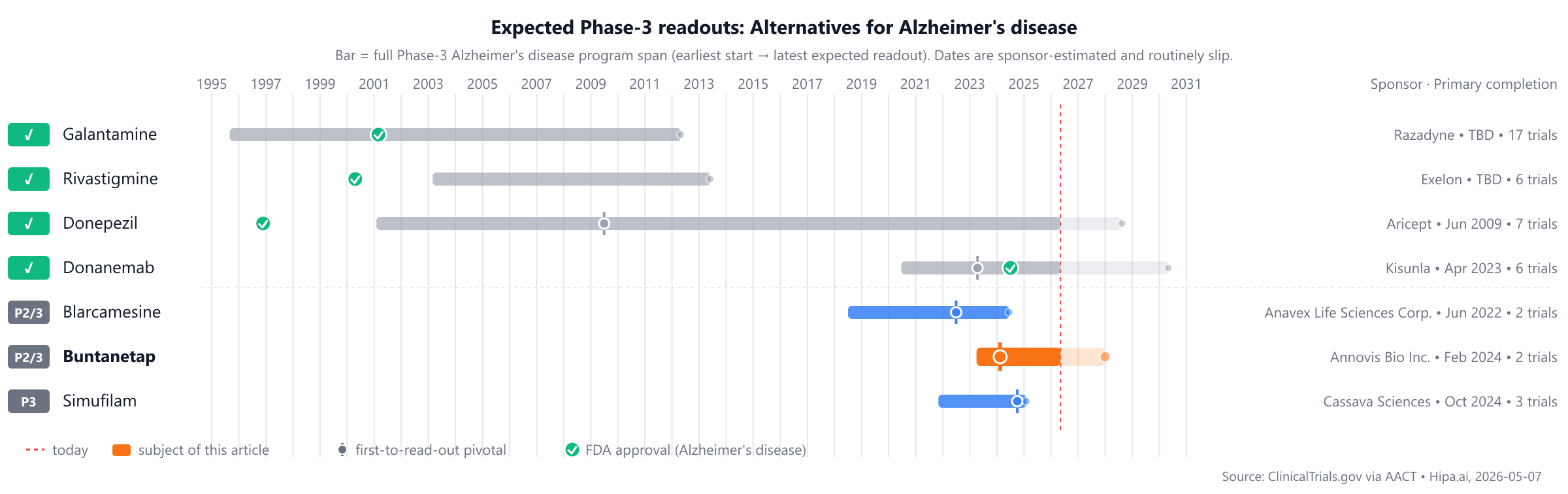
The competitive landscape features long-standing treatments such as Donepezil (Aricept), approved in 1996, and Rivastigmine (Exelon) from 2000. While Buntanetap has not been approved, pipeline drugs Simufilam and Blarcamesine are in Phase 3 development, potentially 1-2 years behind the recent 2024 approval of Donanemab (Kisunla).
Quick comparison table
| Drug | Class | Approved indications | Dosing | Year approved | Lead pivotal endpoint | Annual cost (rough) |
|---|---|---|---|---|---|---|
| Buntanetap | Neurotoxic protein translation inhibitor | — | Oral capsule | Pipeline | — | — |
| Donepezil (Aricept) | Acetylcholinesterase inhibitor | Alzheimer's disease | 5 mg to 10 mg orally once daily for mild-to-moderate disease; 23 mg orally once daily for moderate-to-severe disease | 1996 | Severe Impairment Battery (SIB) score difference: 2.2points @ 24 weeks | $250 |
| Rivastigmine (Exelon) | Acetylcholinesterase inhibitor | Alzheimer's disease, Parkinson's disease dementia | 4.6 to 13.3 mg/24 hours (transdermal patch); 6 to 12 mg/day (oral) | 2000 | — | $635 |
| Galantamine (Razadyne) | Acetylcholinesterase inhibitor | Alzheimer's disease | 16 to 24 mg daily | 2001 | ADAS-Cog 11 score (placebo-adjusted change): -3.9points @ 6 months | $360 |
| Donanemab (Kisunla) | Amyloid beta-directed antibody | Alzheimer's disease | Intravenous infusion every 4 weeks (350 mg for infusion 1, 700 mg for infusion 2, 1050 mg for infusion 3, and 1400 mg for infusion 4 and beyond) | 2024 | iADRS change from baseline: -6.02points @ 76 weeks | $32k |
| Simufilam | Filamin A stabilizer | — | — | Pipeline | — | — |
| Blarcamesine | Sigma-1 receptor agonist | — | Oral, once daily | Pipeline | ADAS-Cog13 change vs placebo: -1.78points @ 48 weeks | — |
Cost estimates are list-price approximations and do not reflect rebates, formulary tier, or out-of-pocket costs after benefits. The class-typical lead-pivotal endpoint here is CDR-SB score change; cells render each drug's actual pivotal endpoint, which may differ. The "Year approved" column shows the FDA approval year for Alzheimer's disease specifically — drugs approved for other indications first appear with their this-indication date, or as Pipeline if not yet approved for this indication. Cross-trial comparisons can mislead — head-to-head Phase-3 data (when present) is below.
Buntanetap vs Donanemab (Kisunla)
No head-to-head Phase-3 trial directly compares Buntanetap with Donanemab.
Cross-trial caveat: the two drugs were tested in different patient populations at different time points. Cross-trial comparisons of response rates can mislead — the only rigorous comparison is a head-to-head randomized trial.
Buntanetap vs Donepezil (Aricept)
No head-to-head Phase-3 trial directly compares Buntanetap with Donepezil.
Cross-trial caveat: the two drugs were tested in different patient populations at different time points. Cross-trial comparisons of response rates can mislead — the only rigorous comparison is a head-to-head randomized trial.
Buntanetap vs Galantamine (Razadyne)
No head-to-head Phase-3 trial directly compares Buntanetap with Galantamine.
Cross-trial caveat: the two drugs were tested in different patient populations at different time points. Cross-trial comparisons of response rates can mislead — the only rigorous comparison is a head-to-head randomized trial.
Buntanetap vs Rivastigmine (Exelon)
No head-to-head Phase-3 trial directly compares Buntanetap with Rivastigmine.
Cross-trial caveat: the two drugs were tested in different patient populations at different time points. Cross-trial comparisons of response rates can mislead — the only rigorous comparison is a head-to-head randomized trial.
Pipeline alternatives
Several investigational IL-17 / IL-17-related drugs are currently in active Phase 3 development. Among these is Simufilam, sponsored by Cassava Sciences, Inc., with its lead Phase 3 trial identified as NCT04994483. Another drug in this stage is Blarcamesine from Anavex Life Sciences Corp., which has its lead Phase 3 trial documented under NCT03790709. Both Simufilam and Blarcamesine are currently in Phase 3, approximately 1-2 years behind other investigational agents like Buntanetap.
Choosing between Buntanetap and its alternatives
Buntanetap, characterized as a neurotoxic protein translation inhibitor, offers a distinct mechanism of action compared to other available Alzheimer's disease therapies. This novel approach may be a consideration for clinicians exploring alternatives to amyloid beta-directed antibodies or acetylcholinesterase inhibitors, particularly in patients who may not have responded to or tolerated existing treatment pathways. While specific efficacy and dosing details for Buntanetap are not provided in this context, its unique mechanism could position it as a potential option in certain clinical scenarios.
Conversely, other therapies present different profiles that may align with specific patient needs and treatment goals. Donanemab (Kisunla), an amyloid beta-directed antibody, demonstrated an iADRS change from baseline of -6.02 points at 76 weeks in clinical studies, and is administered via intravenous infusion every 4 weeks. For patients and clinicians prioritizing established treatment classes, acetylcholinesterase inhibitors such as donepezil (Aricept), galantamine (Razadyne), and rivastigmine have a longer history of clinical use. Donepezil has shown a Severe Impairment Battery (SIB) score difference of 2.2 points at 24 weeks, with once-daily oral dosing available for mild-to-moderate and moderate-to-severe disease. Galantamine demonstrated a placebo-adjusted change of -3.9 points on the ADAS-Cog 11 score at 6 months. Rivastigmine offers both oral and transdermal patch options, which may be a consideration for dosing convenience. These cholinesterase inhibitors generally have well-characterized safety profiles and may be available at a lower cost, influencing treatment selection for specific patient subgroups.
This information is provided for educational purposes only and does not constitute medical advice; clinical decisions regarding patient care should always be made by a qualified healthcare professional.
Sources and methodology
Trial data was pulled from the ClinicalTrials.gov registry via the AACT relational mirror maintained by the Clinical Trials Transformation Initiative. AACT data freshness: .
Cross-trial comparison limitations:drugs without a direct head-to-head trial are compared using each drug's own pivotal trial. These trials enrolled different patient populations at different time points and used different statistical analysis sets. Cross-trial response-rate differences should not be interpreted as proof that one drug is more effective than another.
Related drug pages on Hipa.ai
Not medical advice. This page summarizes publicly-reported clinical trial data for informational purposes. Treatment decisions belong with a qualified prescribing clinician who knows your medical history. Drug approvals, dosing, and safety profiles change over time — always confirm with the current FDA prescribing information.
buntanetapbuntanetap alternativesalternativescomparisonAlzheimer's diseaseanti-amyloid-alzheimersbuntanetap vs donanemabbuntanetap vs donepezilbuntanetap vs galantaminebuntanetap vs rivastigminebuntanetap vs simufilam