Bimekizumab is an IL-17A and IL-17F dual inhibitor approved for plaque psoriasis, psoriatic arthritis, axial spondyloarthritis, and hidradenitis suppurativa. This page compares Bimekizumab to other biologics including Ustekinumab (Stelara), Secukinumab (Cosentyx), Ixekizumab (Taltz), and Brodalumab (Siliq). Its unique dual inhibition of IL-17A and IL-17F offers a distinct mechanism compared to other agents in its class.
Bimekizumab Alternatives: How It Compares to Other IL-17 Inhibitors
Hipa.ai Research · Source: ClinicalTrials.gov / AACT · Last updated: Verified data · 7/7 curated
Source: ClinicalTrials.gov via AACT · Hipa.ai, 2026-05-07Download chart as PNG
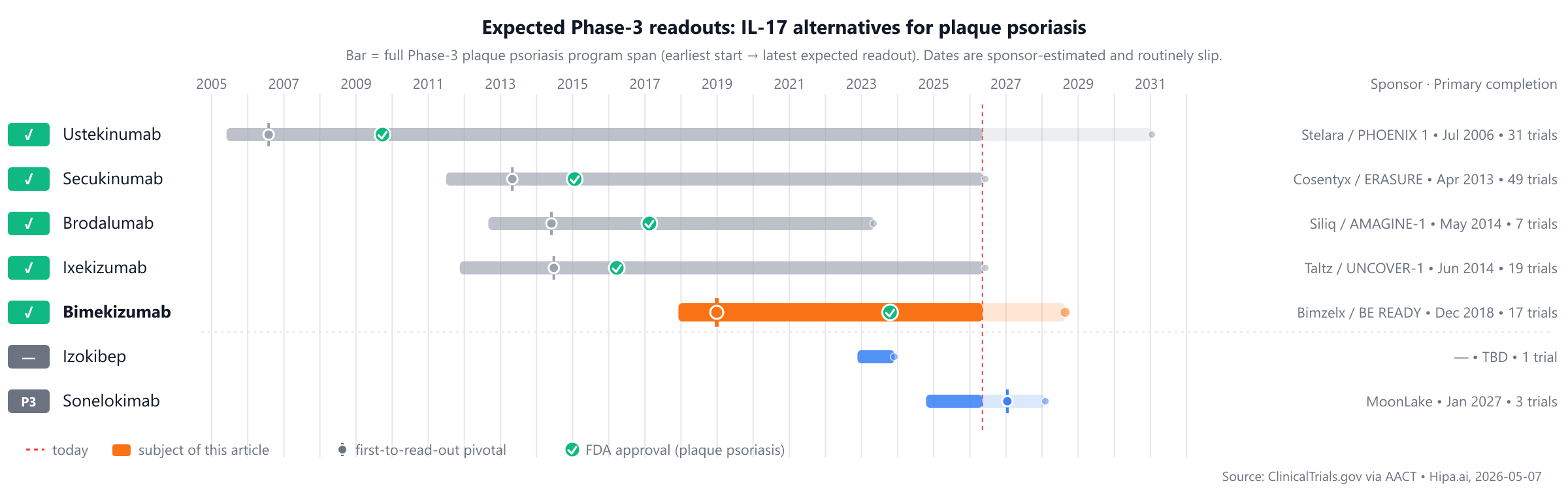
The competitive landscape includes long-standing treatments like Ustekinumab (Stelara, approved 2009) and Secukinumab (Cosentyx, approved 2015), with Bimekizumab entering the market in 2023. Pipeline candidates Sonelokimab and Izokibep are currently in Phase 3, approximately 1-2 years behind the latest approvals.
Quick comparison table
| Drug | Class | Approved indications | Dosing | Year approved | Lead pivotal endpoint | Annual cost (rough) |
|---|---|---|---|---|---|---|
| Bimekizumab (Bimzelx) | IL-17A/F dual inhibitor | plaque psoriasis, psoriatic arthritis, axial spondyloarthritis, +1 more | 320 mg SC at weeks 0, 4, 8, 12, 16, then every 8 weeks | 2023 | 91% @ week 16 | $80k |
| Ustekinumab (Stelara) | IL-12/23 inhibitor (p40) | plaque psoriasis, psoriatic arthritis, Crohn's disease, +1 more | 45 mg or 90 mg SC at weeks 0 and 4, then every 12 weeks (weight-tiered) | 2009 | 42% @ week 12 | $70k |
| Secukinumab (Cosentyx) | IL-17A inhibitor | plaque psoriasis, psoriatic arthritis, ankylosing spondylitis, +3 more | 300 mg SC weekly for 5 doses, then every 4 weeks | 2015 | 59% @ week 12 | $65k |
| Ixekizumab (Taltz) | IL-17A inhibitor | plaque psoriasis, psoriatic arthritis, ankylosing spondylitis, +2 more | 160 mg SC at week 0, then 80 mg every 2 weeks through week 12, then every 4 weeks | 2016 | 71% @ week 12 | $64k |
| Brodalumab (Siliq) | IL-17 receptor A (IL-17RA) inhibitor | plaque psoriasis | 210 mg SC at weeks 0, 1, 2, then every 2 weeks | 2017 | 70% @ week 12 | $30k |
| Sonelokimab | IL-17A/F dual nanobody | — | Investigational; SC dosing in Phase 3 hidradenitis suppurativa and psoriatic arthritis programs | Pipeline | — | — |
| Izokibep | IL-17A inhibitor (Affibody) | — | Investigational; SC dosing in Phase 2/3 psoriatic arthritis | Pipeline | — | — |
Cost estimates are list-price approximations and do not reflect rebates, formulary tier, or out-of-pocket costs after benefits. The class-typical lead-pivotal endpoint here is PASI 90; cells render each drug's actual pivotal endpoint, which may differ. The "Year approved" column shows the FDA approval year for plaque psoriasis specifically — drugs approved for other indications first appear with their this-indication date, or as Pipeline if not yet approved for this indication. Cross-trial comparisons can mislead — head-to-head Phase-3 data (when present) is below.
Bimekizumab vs Ustekinumab (Stelara)
The pivotal head-to-head evidence comes from the BE VIVID trial (NCT03370133) enrolling 567 participants, primary completion 2019-01.
Percentage of Participants With a Psoriasis Area and Severity Index 90 (PASI90) Response at Week 16: Bimekizumab 320 mg Q4W (RS) 85.0 percentage of participants; Placebo (RS) 4.8 percentage of participants; Ustekinumab (RS) 49.7 percentage of participants
Percentage of Participants With an Investigator's Global Assessment (IGA) (Clear or Almost Clear With at Least a 2-category Improvement From Baseline) Response at Week 16: Bimekizumab 320 mg Q4W (RS) 84.1 percentage of participants; Placebo (RS) 4.8 percentage of participants; Ustekinumab (RS) 53.4 percentage of participants
Source: ClinicalTrials.gov via AACT — pulled directly from the trial's posted results. View the full trial record.
Bimekizumab vs Secukinumab (Cosentyx)
The pivotal head-to-head evidence comes from the BE RADIANT trial (NCT03536884) enrolling 743 participants, primary completion 2019-09.
Percentage of Participants With a Psoriasis Area and Severity Index 100 (PASI100) Response at Week 16: ITP: Bimekizumab (BKZ) 320 mg Q4W 61.7 percentage of participants; ITP: Secukinumab 300 mg Q4W 48.9 percentage of participants
Source: ClinicalTrials.gov via AACT — pulled directly from the trial's posted results. View the full trial record.
Bimekizumab vs Ixekizumab (Taltz)
No head-to-head Phase-3 trial directly compares Bimekizumab with Ixekizumab.
In separate pivotal trials, Bimekizumab reported 91% PASI 90 at week 16 (NCT03410992) versus 71% PASI 90 at week 12 for Ixekizumab (NCT01474512).
Cross-trial caveat: the two drugs were tested in different patient populations at different time points. Cross-trial comparisons of response rates can mislead — the only rigorous comparison is a head-to-head randomized trial.
Bimekizumab vs Brodalumab (Siliq)
No head-to-head Phase-3 trial directly compares Bimekizumab with Brodalumab.
In separate pivotal trials, Bimekizumab reported 91% PASI 90 at week 16 (NCT03410992) versus 70% PASI 90 at week 12 for Brodalumab (NCT01708590).
Cross-trial caveat: the two drugs were tested in different patient populations at different time points. Cross-trial comparisons of response rates can mislead — the only rigorous comparison is a head-to-head randomized trial.
Pipeline alternatives
Among investigational IL-17 / IL-17-related drugs in active Phase 3 development is sonelokimab, from MoonLake Immunotherapeutics AG. Sonelokimab is a tri-specific nanobody designed to inhibit IL-17A, IL-17F, and IL-17A/F. This mechanism is similar to bimekizumab's dual inhibition of IL-17A and IL-17F. The lead Phase 3 trial for sonelokimab is NCT06641089.
Another investigational agent in active Phase 3 development is izokibep. Izokibep is an IL-17A nanobody, distinguishing its mechanism from bimekizumab's dual inhibition of both IL-17A and IL-17F. While bimekizumab is an approved treatment, these investigational therapies are currently undergoing evaluation in clinical trials.
Choosing between Bimekizumab and its alternatives
When considering treatment options for plaque psoriasis, bimekizumab, an IL-17A and IL-17F dual inhibitor, offers a distinct mechanism of action compared to other available biologics. This dual inhibition targets both key cytokines in the IL-17 pathway, which may be a consideration for clinicians seeking a comprehensive approach to IL-17-mediated inflammation. The choice of therapy often involves weighing factors such as mechanism, patient history, and individual response goals.
Alternative biologics provide varied profiles that may be preferred in different clinical scenarios. Ustekinumab (Stelara), an IL-12/23 inhibitor, achieved a PASI 90 response in 42% of patients at week 12 and offers a less frequent maintenance dosing schedule of every 12 weeks after induction. Among IL-17 pathway inhibitors, secukinumab (Cosentyx), an IL-17A inhibitor, demonstrated a PASI 90 response in 59% of patients at week 12. Ixekizumab (Taltz), also an IL-17A inhibitor, showed a PASI 90 response in 71% of patients at week 12. Brodalumab (Siliq), an IL-17 receptor A inhibitor, achieved a PASI 90 response in 70% of patients at week 12. These agents have established clinical track records, different dosing frequencies, and varying efficacy magnitudes, which clinicians may consider based on patient-specific needs, prior treatment experiences, and other individual factors. Ultimately, the decision of which medication to prescribe rests with the clinician, taking into account the full patient profile and available evidence. This information is not medical advice.
Sources and methodology
Trial data was pulled from the ClinicalTrials.gov registry via the AACT relational mirror maintained by the Clinical Trials Transformation Initiative. AACT data freshness: .
Head-to-head trials cited on this page:
- NCT03370133 — BE VIVID: Bimekizumab vs Ustekinumab · A Study to Evaluate the Efficacy and Safety of Bimekizumab Compared to Placebo and an Active Comparator in Adult Subject…
- NCT03536884 — BE RADIANT: Bimekizumab vs Secukinumab · A Study to Evaluate the Efficacy and Safety of Bimekizumab Compared to an Active Comparator in Adult Subjects With Moder…
Cross-trial comparison limitations:drugs without a direct head-to-head trial are compared using each drug's own pivotal trial. These trials enrolled different patient populations at different time points and used different statistical analysis sets. Cross-trial response-rate differences should not be interpreted as proof that one drug is more effective than another.
Related drug pages on Hipa.ai
Not medical advice. This page summarizes publicly-reported clinical trial data for informational purposes. Treatment decisions belong with a qualified prescribing clinician who knows your medical history. Drug approvals, dosing, and safety profiles change over time — always confirm with the current FDA prescribing information.
bimekizumabbimekizumab alternativesalternativescomparisonplaque psoriasisil17-plaque-psoriasisbimekizumab vs ustekinumabbimekizumab vs secukinumabbimekizumab vs ixekizumabbimekizumab vs brodalumabbimekizumab vs sonelokimab